
Goalkeeper Distribution: How to Throw, Kick and Pass
Every way to get the ball out, with your hands and with your feet: how to do each one, when to use it, and how to train it on your own.
The ball is played back to you. A striker is already running at you, and your stomach drops before the ball even arrives.
I know that feeling better than most. When I started out in goal, my distribution was humiliating. Goal kicks that barely left the box. Side volleys that floated straight up like a balloon. I was a good shot stopper, quick on my line, and none of it mattered, because all anyone talked about was my feet.
So I hid. I stood behind my defenders so they would not pass back to me, and I cleared every back pass first time, as high and as wide as I could, because I was scared. It took me years of training on my own to fix it. This guide is everything I wish someone had shown me at the start.
Goalkeeper distribution is every way you get the ball back into play: rolling and throwing with your hands, side volleys and half volleys out of your hands, passes with your feet, and goal kicks. Pick the option that reaches a team-mate fastest and safest, then train each technique on both sides until it feels automatic.
What counts as goalkeeper distribution?
Anything you do to start an attack. Once you have the ball, you are not just the last line of defence any more. You are the first player in your team's attack.
They fall into a few groups, and you need all of them:
- With your hands: the roll, the overarm throw and the sidearm throw
- Out of your hands with your feet: the side volley, the half volley and the punt
- From the ground: your first touch, short passes, long passes and goal kicks
Each one has a job. The skill is not only striking the ball well. It is picking the right one in the second you have.
How do you roll the ball out?
The roll is the most underrated technique a goalkeeper has. It is not flashy, but you use it all the time: a short ball to a full back or centre back when there is no pressure, or when your team wants to keep the ball and build from the back.
- Hold the ball in both hands
- Step into the roll with your opposite foot
- Get low and release the ball just above the ground
- Let it touch the ground early
That early contact with the ground is the whole point. A ball that lands early rolls clean and true, so your team-mate can control it with one touch. A ball dropped from waist height bounces, and now their first touch goes on taming it.
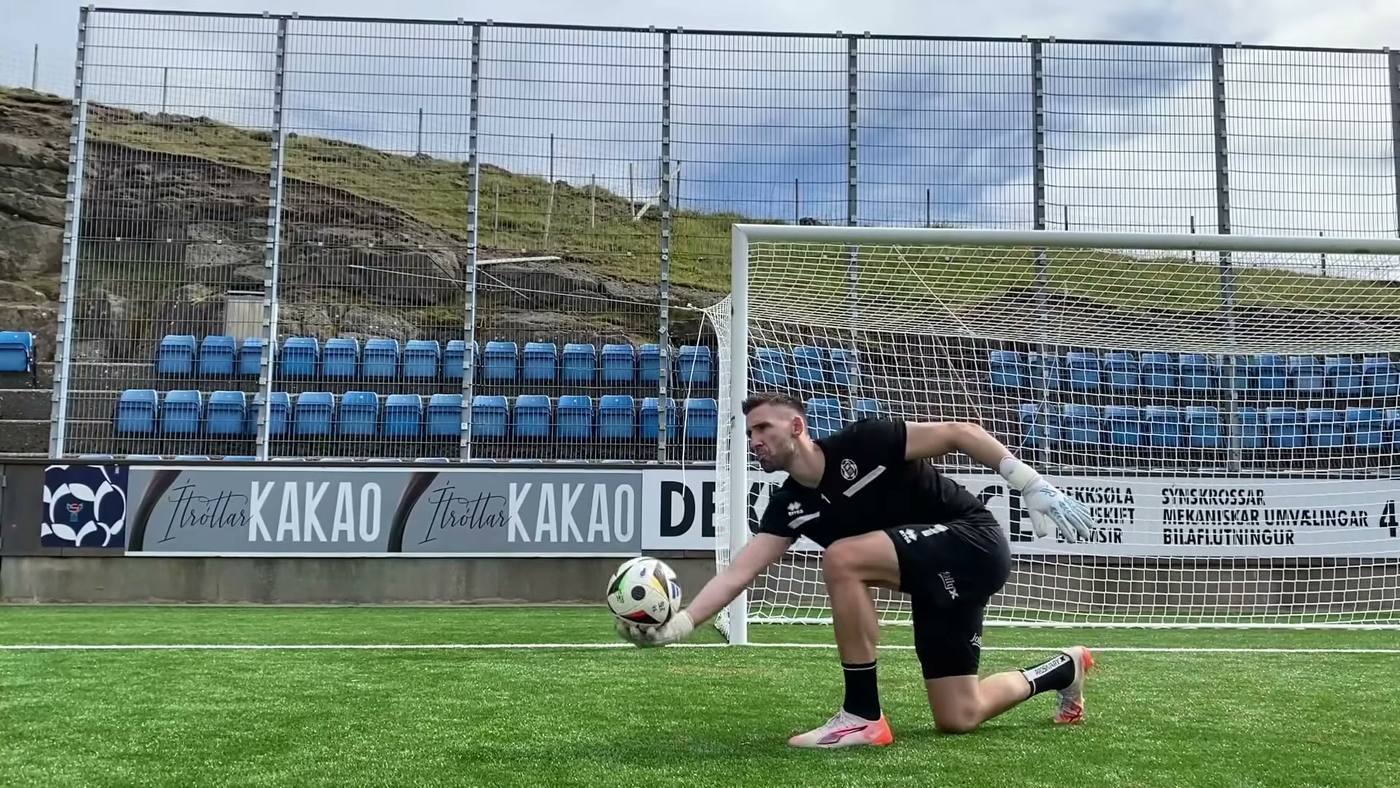
If you can roll it, roll it.
How do you throw the ball overarm?
When a winger is ready to run and you need to get the ball to him now, the roll is too slow. That is the job of the overarm throw: starting a counter attack, getting the ball out wide fast, or skipping a line of pressure.
- Hold the ball in your throwing hand, arm stretched back
- Step forward with your opposite foot
- Point your other arm at the target for balance and aim
- Swing the throwing arm over your head, close to your ear
- Release around eye height
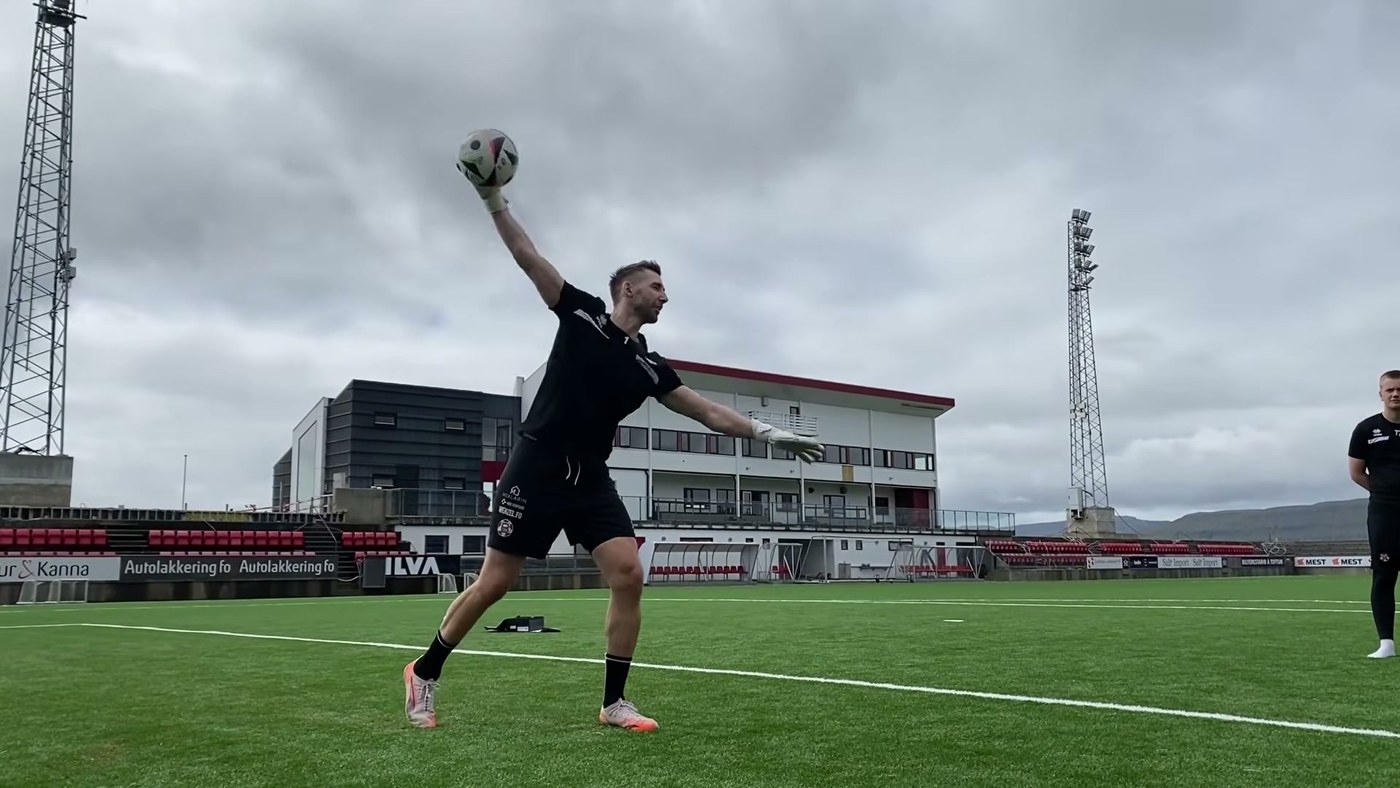
Where you let go changes the flight. Release a little earlier and the ball travels upwards, which helps when you are throwing over an opponent. Release a little later and it travels down, which is what you want when you are aiming at a team-mate's feet.
Done properly, an overarm throw travels in a straight line. That makes it far easier to control than a ball that spins and curls. If your throws keep getting intercepted, the usual reason is in my post on bad goalkeeper habits: throwing like a discus thrower.
A quick throw can win you a game. Neelu, one of the goalkeepers I coach, had an assist from one on the day of her first call with me. She made a low dive to her left, got up and, in her words, "just found my player in the middle and like gave her a hard throw". Her team-mate turned and took it up the pitch.
When should you use a sidearm throw?
You can also throw the ball sideways, with your arm swinging round at shoulder height instead of over your head. This is more advanced.
It is useful when you want to bend the ball around an opponent and into a team-mate's feet. But a ball thrown this way spins, and a spinning ball is harder to control. So only use it when your team-mate has a bit of space around them.
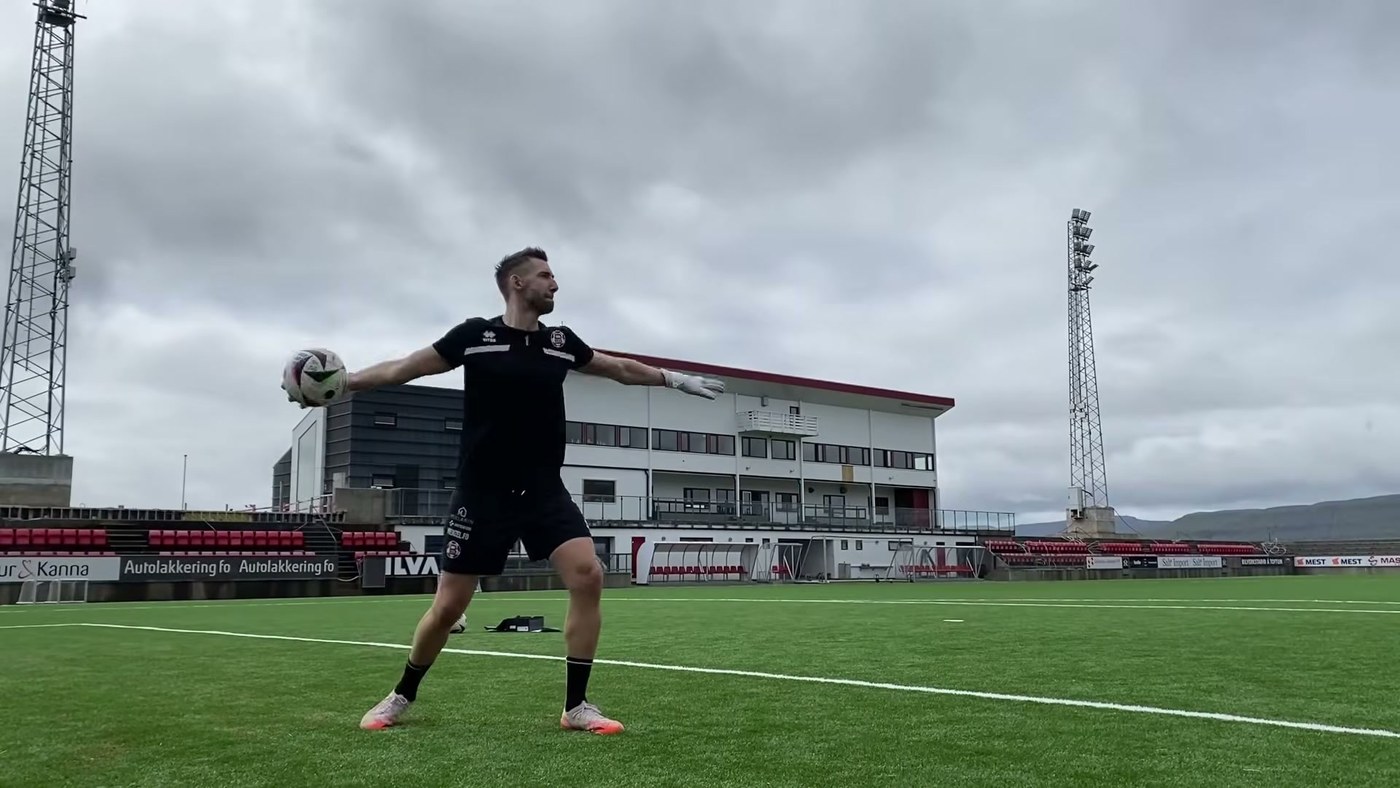
For everything else, overarm is the safer choice. I break down the roll and both throws side by side in the video at the top of this guide.
How do you hit a side volley?
The side volley is my favourite distribution technique, and most goalkeepers use it today. When I grew up, most keepers launched the ball up the pitch with a drop kick. The side volley is lower and faster, so the other team has less time to get back before the ball reaches its target.
Use it to hit a team-mate fast and low, or to drive the ball into space behind the other team.
- Ball in your opposite hand
- Turn your side to the target
- Toss it up to between hip and chest height
- As it drops, lean away from it
- Swing across and strike with your laces, ankle locked
Hold the ball in your left hand if you are right-footed, and the other way round. Aim to strike through the middle of the ball, or just below it.

Leaning away is the part people miss. It lets you get your leg up higher. Without it, you are just kicking an old-school volley up the field.
Technique over power. Focus on the contact and the power follows. If you try to smash the ball, you will never learn the side volley. When I hit a bad one, it is nearly always because I lost focus and struck below the centre of the ball.
A good way to start: put the ball on top of a tall cone at the height where you would strike it, and practise the contact without having to drop the ball. When that feels right, go back to a real side volley. I show it in Goalkeeper's SECRET Distribution Weapon, and the side volley and the half volley together in The Side Volley Technique Every Goalkeeper Gets Wrong.
What is the difference between a half volley and a punt?
Both come out of your hands. The difference is when your foot meets the ball.
The punt is struck straight out of the air, before the ball touches the ground. It is the old-school kick you still see at every level. It goes high and long, but it hangs in the air for a long time, which often turns it into a fight for the header.
The half volley, sometimes called a drop kick, is struck just after the ball hits the ground. It is still more of a kick-it-long technique, but it works, especially when you need maximum distance or it is windy.
- Hold the ball in one or both hands
- Drop it and step in with your plant foot
- Strike just after it bounces
- Laces through the bottom third, ankle locked
- Follow through with your hips and upper body
Timing is everything here. Strike it before the bounce and it is just a punt. Leave it too long and the timing gets very hard.

Get the timing right and the ball climbs with a little backspin. That helps it hang in the air a bit longer, so your team-mates have time to get under it or chase it.
How do you pass the ball with your feet?
This is where most young goalkeepers feel the panic. And the truth is, it is usually not your passing that is the problem. It is your first touch and your pass not working together.
Your first touch
There are two touches you will use more than any others.
- The push touch. Your most common one, for when there is no pressure. Use the inside of your foot and push the ball slightly forward and slightly out to your stronger side, about a metre, a metre and a half at most. Too far and a striker gets to it. Too close and it rolls under your feet.
- The cross touch. For when pressure comes from one side. Use the foot nearest the pressure to bring the ball across your body, away from the striker, and open up a new lane to pass or kick with the other foot.

Without a good first touch, your kicking almost does not matter. Practise both slowly first, then add speed and pressure.
Short passes
The inside pass is the most accurate pass in football, and it should be your go-to for anything short.
- Open your hips slightly so your passing foot faces the target
- Lock your ankle
- Strike the middle of the ball with the flat inside of your foot
- Follow through towards your target
- Keep your hips over the ball and your upper body still
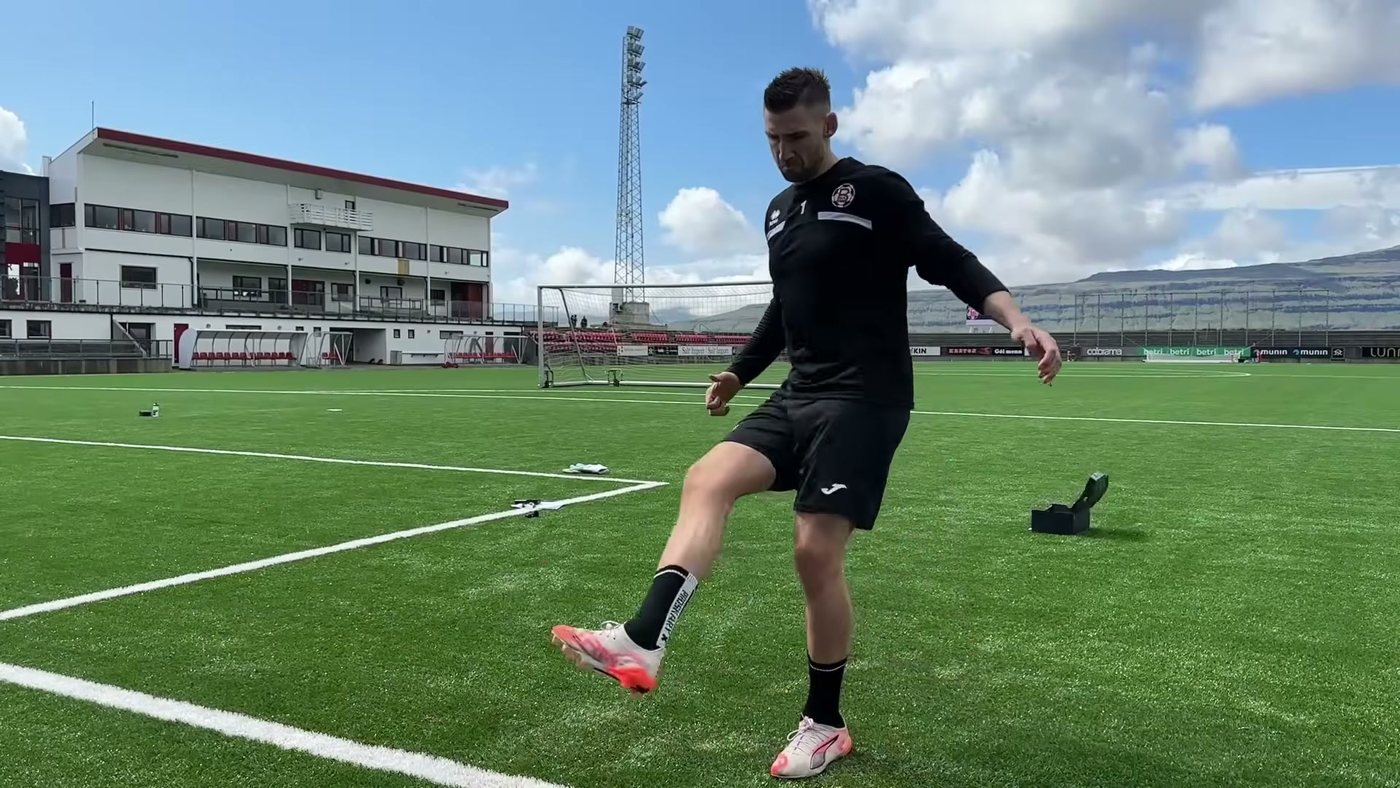
Lean back or twist, and the ball lifts or wobbles. For a longer ball along the ground, like a switch to the other full back, use the laces pass: approach at a slight angle, lock your foot and strike through the centre with your laces. It is faster and covers more ground, but it is riskier.
My rule is simple. If the pass is short and you are unsure, use the inside of your foot every time. Both touches and both passes are in Short Passing Made Easy for Goalkeepers.
Long passes
For longer balls there are two strikes, and they do very different jobs.
- The clipped pass lifts the ball and drops it softly into space or to a team-mate. Approach at a slight angle, lock your ankle, strike under the ball with the bony part near your big toe, and follow through gently for backspin.
- The driven pass is lower, faster and more direct. Strike through the lower middle of the ball with your laces, foot straighter than for the clip, and keep the follow-through very short.
Going over the pressure? Clip it. Going through it? Drive it. The clip was the first long pass I learned, and it is the easier one to start with. Both are broken down in Your Goalkeeper Distribution Was Wrong.
Look up first
Even now, I sometimes try to be more of a ball-playing goalkeeper than I really am, because I think that is what people expect from me. And I have played passes without looking first. That is a big mistake.
Before the ball reaches you, look up and know where your pass is going. The best pass is the one you have already picked.
What about goal kicks?
Goal kicks are a big topic on their own, and they get their own guide. The short version: a good goal kick comes from the setup, not the swing. Step back and a little to the side, run at your plant foot, strike through the bottom half of the ball with your ankle locked, and swing at about 80% rather than as hard as you can.
The full routine, from where to place the ball to what to do if your kicks are not long enough yet, is in how to take a goal kick as a goalkeeper.
How do you choose the right distribution?
This is the part no technique video can do for you. In a game you have a second or two to decide, so it helps to have a simple guide in your head.
- Short, no pressure: roll it, or play an inside pass
- Counter attack, team-mate in space: overarm throw or side volley
- Over the pressure: clip it, or release your throw a little earlier
- Through the pressure: a driven pass or a fast side volley
- Maximum distance or a strong wind: half volley
- Short and unsure: inside of the foot, every time
Osman, a 15-year-old in my programme, asked me the question every keeper asks sooner or later: "The CBs are marked. The right backs are marked... Who am I supposed to play to?"
Sometimes the honest answer is nobody short. Then going long into space is the right decision, not a failure. Not every ball has to be played out from the back.
Two rules matter here as well. You now have eight seconds with the ball in your hands before the referee gives the other team a corner, so you cannot wait forever for the perfect option. And you cannot pick up a ball a team-mate deliberately kicks back to you. The eight-second rule and the back-pass rule, including the one time you can pick it up, are both explained in my goalkeeper rules post.
What distribution drills can you do on your own?
You do not need a coach for this. I fixed my distribution with a ball, an empty pitch and a lot of frustration. These are the drills that made the biggest difference.
- Wall passing. Pass to a wall, control the return and pass into a target. Change the control each time: inside of the foot, outside of the foot, drag it across with your other foot, first time, first time with your weaker foot, and a fake before the pass. Four to six of each.
- Clear the crossbar. Balls on the penalty spot, pick a spot above the bar and hit it. Head down until after contact, chest lifted slightly. Eight to ten with each foot.
- Hit the net from distance. Go out to whatever distance challenges you without wrecking your technique. I use 35 to 40 yards. Aim for the back of the net, then for the crossbar.
- Side volleys off a cone. The contact drill from above, then real side volleys at two markers.
- Rolls and throws, both sides. Pick a target, roll it, then throw it, with your left and your right.

Train both feet and both hands, especially for short passes. Being good on both sides makes you a far more reliable goalkeeper. I show the kicking drills in Distribution Drills That Changed My Game, and every distribution drill on the channel is sorted on the goalkeeper drills page.
Quality beats quantity. Ten good kicks with your full attention are worth more than fifty tired ones.
What to do this week
Pick the one that hurts you most in games.
One problem, one week.
- Panic on back passes? Wall passing, and the push touch until it is automatic.
- Throws getting cut out? Overarm, released around eye height, ten to each side.
- Side volleys going up like a balloon? Lean away, and start from the cone.
- Not sure what to pick in games? Learn the guide above, and look up before the ball arrives.
You do not have to be a playmaker. You just have to stop being scared when the ball comes back to you.
Know the techniques, but still panic when it is played back to you?
Knowing how to strike a side volley and doing it with a striker running at you are two different things. What closes the gap is a plan you follow week after week, not a pile of drills.
The Ultimate Self-Training Program gives you a weekly plan built from over 120 drills you can do on your own, and the six-week Goalkeeper Playmaker Blueprint for distribution unlocks inside it as you go. $27 a month.
See what is inside the program 30-day money-back guarantee if it is not helping.
I have played more than 500 competitive games over 20+ years, represented my national team, and played in Champions League and Europa League qualifiers. My distribution was the weakest part of my game when I started, and I fixed it training on my own. I have since coached over 1,000 goalkeepers.
Enjoyed this article?
Find more great content here: