
Goalkeeper Drills: The Complete Library, Sorted by Skill
Every drill on the channel, sorted by the skill it fixes, with the video for each and the deeper guide where one exists. Pick your weakness and go.
Most goalkeeper drills online are the same three things filmed on a nicer pitch. A cone ladder, a few shots from a coach, and a caption telling you to work hard.
You do not need more drills. You need the right drill for the thing that is actually costing you goals, and a way to do it on your own.
This page is every drill from the Ground Glory channel, sorted by skill, with the video for each and the deeper guide where one exists. Pick your weakness, read that section, and go.
The best goalkeeper drills isolate one skill, start from a controlled position and build up to game speed. Handling starts on your stomach against a wall, diving starts seated, footwork starts with four cones in a two-metre square, and distribution starts with a wall and both feet. Fifteen focused minutes, three or four times a week, beats one long session.
How do you use this page?
Do not try to do everything. That is how you end up busy and not better.
Pick the section that matches the goal you conceded last week. Read the drills, watch the video, and do that one thing for a week.
Three rules apply to every section below.
- Start low, build up
- A wall and a ball is enough
- Stop before your technique falls apart
Start low, build up. Nearly every drill has a version on your knees or sitting down. That is not the beginner version, it is how you build the pattern safely before you add speed and impact.
A wall and a ball is enough. Most of what follows needs no partner and no goal. If you have a partner, better. If you do not, you can still get 200 repetitions in.
Stop before your technique falls apart. Fifteen good minutes beats forty tired ones. Practising a collapsing technique is worse than not practising.
If you want all of this in a weekly plan, that is the training plan guide, and it is coming to this site in early October.
Handling and catching drills
Catching is the most important skill in goalkeeping and the one most young keepers never train on purpose. These five build the technique in order, and they need a ball, a partner if you have one, and a wall if you do not.
If you are starting from scratch, the older walkthrough Goalkeeper Handling Drills: 5 Easy Steps for Beginner Mastery takes the same five steps more slowly.
The W catch on your stomach
Lie on your stomach, hands out in front of your face. Your partner throws the ball, you catch it in the W shape (thumbs together behind the ball, fingers spread), and throw it back. Being on your stomach removes your legs and your body from the catch. Only your hands can save you, so only your hands get trained.
Seated catches
Sit on the ground, legs out in front. Same catch, same throw back. Professional goalkeepers use this in warm-ups because it limits body movement and forces the hands to do everything.
Kneeling low balls
Kneel up. Now the balls come in low. Eyes locked on the ball, slow it down with soft hands, get your head down over it, and lock it into your body.

The basket
Still kneeling, but now the ball comes at your stomach. Do not use the W here, it does not work at that height. Elbows together, forearms make a basket, the ball drops in, and you fold over it. If your partner keeps hitting your chest instead, have them throw rather than kick. Power does not matter for this one. Technique does.
Everything at once
Kneeling again. Now your partner chooses: low ball, stomach ball, chest ball, high ball, thrown or kicked or rolled. You have to pick the right technique in the time you have. This is the one that turns technique into reflexes, because you are deciding as well as catching.
Every one of these works against a wall. Throw, catch the rebound, repeat. Move closer as it gets easy.
Deeper guides: the three catching techniques by height, the wall drills that build reflexes, and the training habit that ruins handling for most young keepers.
Reflex drills
Reflexes are trainable, and the training is repetition at close range with the pace and angle constantly changing. Four wall drills cover it.
Wall throws. Stand a few metres from a wall, throw or kick the ball against it, save the rebound. Vary the power and the angle every time. If you settle into a rhythm you are practising rhythm, not reactions.
Ground rebounds. Sit with your legs apart, throw against the wall, save the ball as it comes back along the ground. Your legs are out of it, so your hands do everything. Best drill there is for low reactions, and low is where most goals go.
High ball catches. Throw high against the wall, get under it, catch or tip it over as it drops. Reaction and footwork together.
Sit-up toss. Lie down. As you come up into a sit-up, throw at the wall and catch the return. Core and hands in the same movement, and you arrive at the ball off balance, which is realistic.
Add a second ball. Two balls turns a reaction drill into a decision drill, which is much closer to what a match asks of you.
Deeper guide:how to improve your goalkeeper reflexes, including how to react to a ball that comes through a crowd.
Diving drills
Every goalkeeper has had a weak side and a fear of landing. Both are fixed the same way: teach your body the ground is safe before asking it to trust you at height.
The earlier set, 5 Essential Goalkeeper Diving Drills You Can't Ignore, runs through the same progression if you want a second look at it.
The progression, from seated to full dive
- Seated: glide out with the ball, bottom hand on the grass
- On your hip: extend for a rolled ball, land soft
- On your knees: range increases, same hands
- One knee, one foot: add the power step
- Full dive, always forward, never backwards
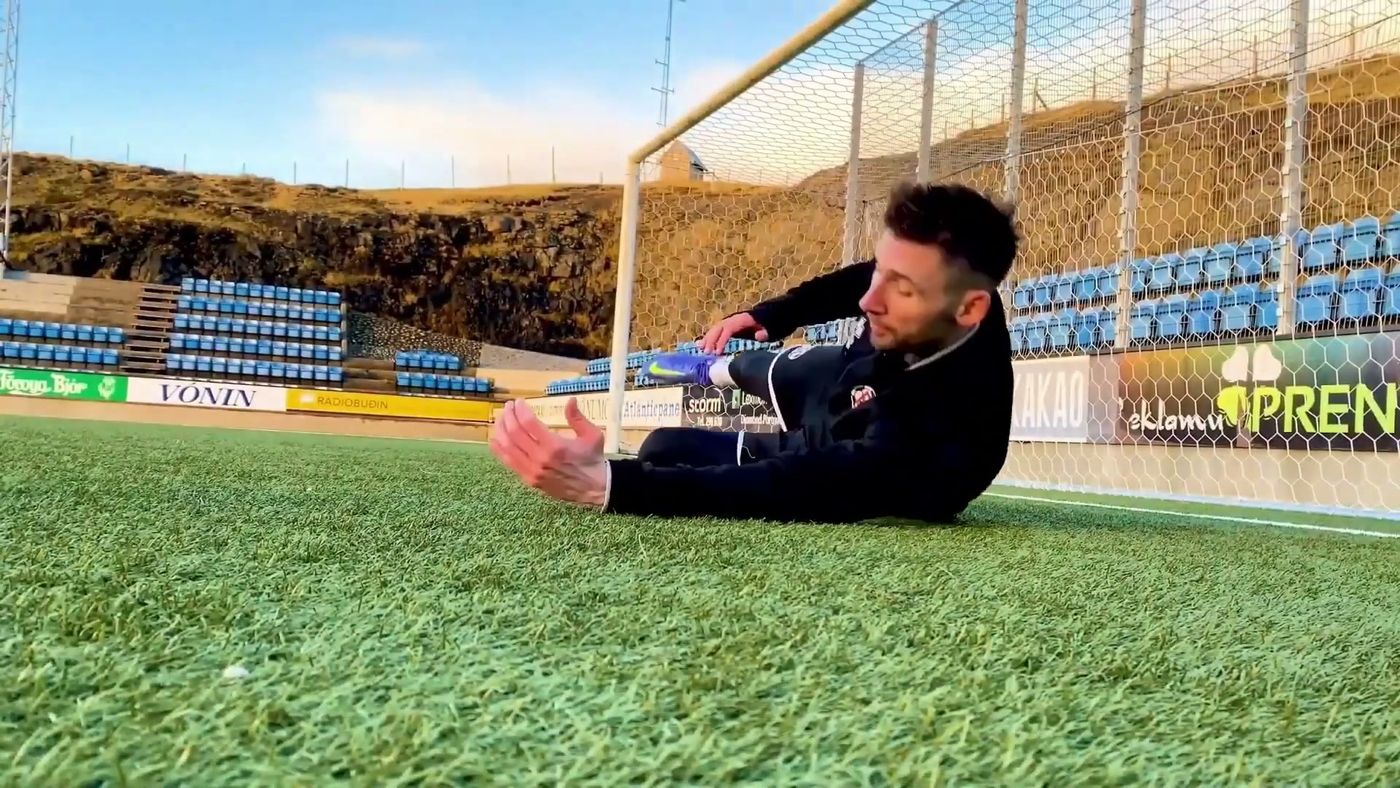
Seated. Sit on the ground with the ball in your hands. Glide out sideways with it and catch it in front of your body. Arms in front, bottom hand as close to the ground as you can get it, one hand on top of the ball and one behind. No height, no impact.
On your hip. Sit on one hip. Extend for the ball a partner rolls, or place it and reach. This trains a soft landing, and it teaches the bottom hand to stay glued to the grass so nothing goes under you.
On your knees. Range increases. Same hand shape. Use the ground as your third hand.
One knee, one foot. Half-kneeling, other foot flat. Now you have a power step. Push off the standing leg into the dive and land in a forward position with your hands on the ball.
Full dive. From the power step, then from a normal standing position with a step. Always forward, never backwards. A dive that goes backwards covers nothing.
Fixing your weak side, alone
Five drills, ten to fifteen minutes a day, nothing but a ball.
On both knees, ball in hands
Drop to your weak side with your chest over the ball. Guide yourself down. Do not twist, do not land flat on your back. Glide down through the side of your hip and thigh, in control.
One knee down
Same movement with a step into it. Lower hand low and strong. Land in a controlled motion, no flopping.
Ball placed away
On your knees, ball a reach away on your weak side. Small power step, extend, shoulder over your knee, bottom hand tight to the ground. Let that hand drift up and there is a gap under your body for the ball to slip through.
Standing, step then dive
Step to your diving side, push off the back foot, drive through the ball. Chest forward. If your weight goes backwards you lose the dive.
The cone touch
Put a cone one or two steps on the opposite side. From your set position, step and touch it, then push off and dive to your weak side. Reactions, footwork and diving in one.
Step first, dive second. Dropping straight down covers nothing.

Landing. For a collapse dive at mid height, take a step, go with gravity rather than fighting it, and land with your hands facing up so your shoulder and elbow take nothing. The side of your knee and the side of your shoulder should hit the ground at the same time. Never land on the point of your knee or your elbow. On soft ground, with a soft ball, until it feels like nothing.
Deeper guides: the four diving techniques every keeper needs, why low shots keep slipping under your hand, how to get up faster after a save, and how to overcome fear as a goalkeeper.
Footwork drills
Two movements do almost all of a goalkeeper's work. The side step, led with the foot nearest the direction you are going, short and light, for short distances. The crossover, for covering ground fast, one step then straight back into a shuffle. Both finish with you set and still before the shot.
The square: seven drills in two metres
Four cones in a two-by-two metre square. That is the whole setup.
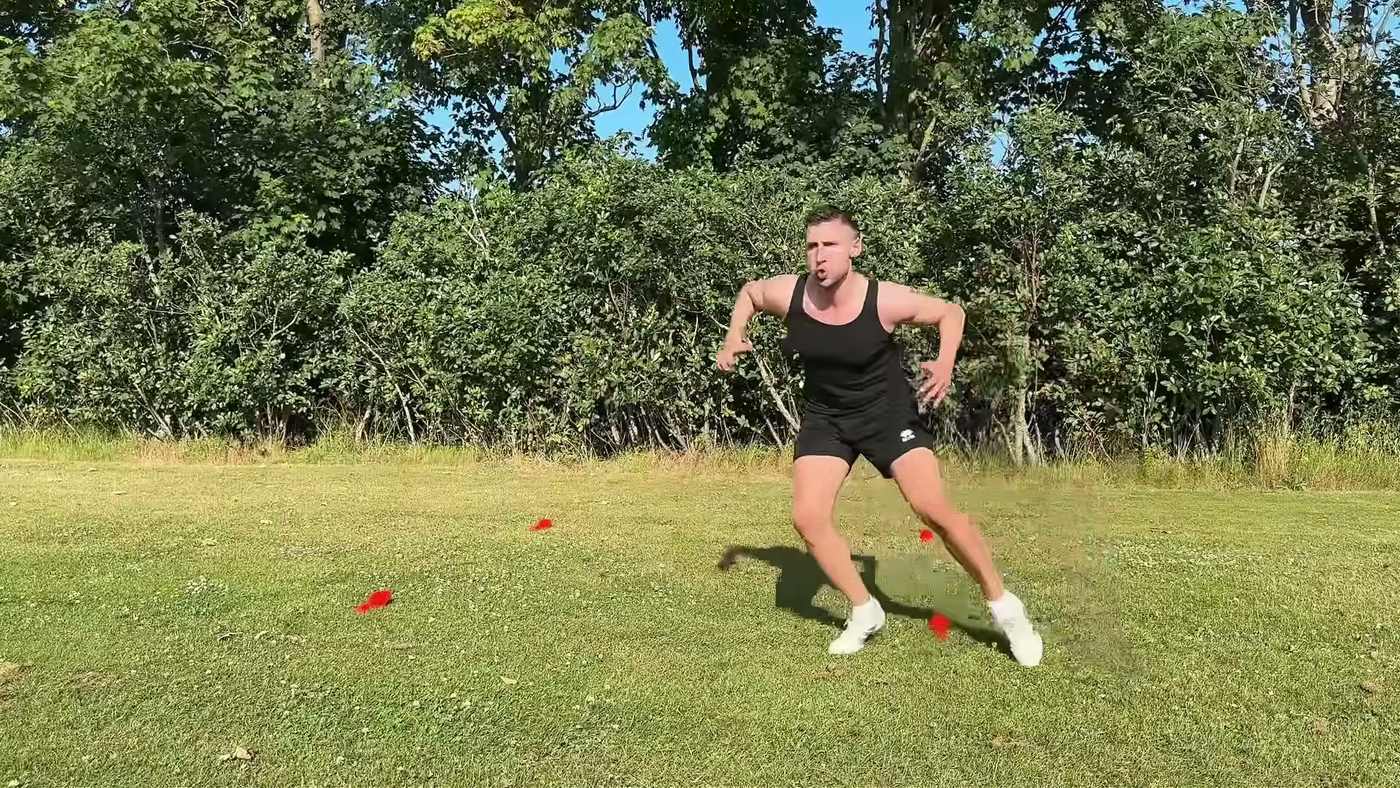
- Run, side step, back pedal, side step. Run up one side, side step across the top, back pedal down the far side, side step across the bottom. Three rounds, rest, three rounds the other way. Get set at every cone.
- The same route with crossovers. Speed is easy. Stopping is the hard part. Slow down and stop for half a second at every corner.
- Eyes on the ball. Pick a spot in the middle of the square. Go round the outside with side steps without ever losing sight of it. Your feet learn the route, your eyes stay on the game.
- The same with crossovers. Chest and eyes still facing the middle. The corners get awkward. Slow down, set, turn back to the middle, move again.
- The S pattern. Short side steps weaving in and out of the square like drawing an S. Legs will burn. Keep the steps small and the final set position as sharp as the first.
- The S with crossovers. Small steps through the first S, then open your stride and cross over. This drill is about changing gears.
- The zigzag. Sharp diagonals in and out of the square. Plant the outside foot and push the ground away. The keyword is sharp.
Stop and start across the goal
Five cones across your goal line. Shuffle to each one and come to a complete stop, knees bent, weight centred, before exploding to the next. Then add a cross step. Then put a cone in the middle and add an explosive drive out, stop, and back pedal.
The far-post version puts two cones at the distance you need to cover for a far-post save. Two quick, sharp cross steps get you there before the ball does.
The ladder
A speed ladder is useful and completely optional. Cones or shoes work. The drills worth doing: one foot in each square, two feet in each square, sideways in and out, the icky shuffle, the 3-2-1 (three forward, one back), single-leg hops, skater jumps, and a burst into a short sprint at the end with a hard stop.
Deeper guides: the footwork movement nobody teaches, and the positioning mistakes that footwork has to fix.
Distribution drills
I was known for the wrong reasons as a young goalkeeper. My kicking was poor and it got noticed. It did not improve until I started doing something about it on my own, and these are the drills that changed it.
Wall passing, six variations
Pass to the wall, control the return, pass into a target. Then vary the control: instep, outstep, drag across with the other foot, first time, first time with the weak foot, and a drag-fake-drag before the pass. Four to six repetitions of each. Both feet, especially for short passes.

Clear the crossbar
Line balls up on the penalty spot, or use one ball and fetch it. Pick a spot above the bar and hit it. Head down until after contact, chest lifted slightly to get the ball up. Eight to ten kicks each foot. Your weak foot will not clear it every time. Keep your head down anyway.
Hit the net from distance
Move out to 35 or 40 yards, or whatever distance challenges you without wrecking your technique. Aim for the back of the net. Then aim for the crossbar. Head down until after contact, every time.
Control, then find the winger
Four variations of receiving and creating space before the kick: sole drag to your strong foot, sole drag then instep touch, opposite-foot drag then outstep, opposite-foot drag then instep. Each one is a match situation: ball from a defender, control, pass to a wide player.
Deeper guides: how to take a goal kick as a goalkeeper, and the throwing habit that gets intercepted when the ball is in your hands.
1v1 drills
1v1s are techniques first and drills second. Learn the four, then rehearse them with a partner dribbling at you.
The older breakdown, Are You Missing These 1v1 Goalkeeper Techniques?, covers the four techniques one at a time.
The smother. Sprint out, go down on your side and slide towards the ball with one hand behind it and one on top, head behind the ball. For through balls and heavy touches. If you cannot get there first, go through the ball with your body and keep one hand up for the chip.
The spread. Get as close to the striker as possible and make yourself as big as possible. Covers a lot of goal, but you are fully committed and open between the legs. Do not turn your body. Head down, be brave.

The block, or K save. One knee down at ninety degrees, one foot planted, hands shaped like a K. Best from the sides where the angle is narrow. Less committed than the spread, still able to react with the hands.
Wait and react. Most of the time, this is the right one. Long-range 1v1s and tight angles are not big chances. Trust your position and let the striker make the decision.
A partner dribbles inside your box. You close the space with small steps, stop and set when they look ready to shoot, and pick the technique. When they look down at the ball or take a heavy touch, that is when you go.
Deeper guides: positioning for 1v1s, how to deal with crosses without panicking, and how to save a penalty, the 1v1 with the most time to think.
Jumping, leg power and core
Explosiveness is what turns a good dive into a save you should not have reached. None of this needs a gym.
The ten plyometrics below are demonstrated one by one in 10 Crazy Easy Plyometric Drills for Goalkeepers.
Ten plyometrics, no equipment
Pogo jumps (three sets of 25 seconds), squat pulses (3x20), squat jumps (3x12), tuck jumps (3x8), jumping lunges (3x12), single-leg jumping lunges (3x8 each leg), skater jumps (3x12), broad jumps (3x6), kneeling jumps (3x6), and counter-movement jumps (3x8).
Pick three or four, two or three times a week. Not all ten, not every day.

The ten-minute leg workout
Forty-five seconds on, fifteen off, or thirty and thirty if that is too much. Squat pulses, slow squat and explode, squat to jumping jack, four-second hold and explode, fast down slow up, low in-and-outs, hold and jump, jumping jacks, low side steps, and squat jumps to finish. Keep your core tight and breathe.
The ten-minute core workout
Same timing. Ball between your knees and crunch, heel taps with the ball between your feet, Russian twists, toe touches, explosive sit-up to the ground, ball kicks, plank rolling the ball under you, side plank reaching the ball behind you both sides, and a slow sit-up with the ball in front of your face to finish.
The core matters more than it looks. The spin to get up after a full-stretch dive is a core movement. So is diving further and landing safely.
Bodyweight only, soft surface, and stop when the form goes. Two short sessions a week is plenty while you are still growing.
Warm-up and recovery
Diving before you are warm is where goalkeepers get hurt, and what you do in the ten minutes after a match decides how you feel tomorrow.
The warm-up runs in a fixed order: movement, activation, core, feet, passing, hands, then diving close before far, then match-realistic shots, then distribution. About thirty minutes.
Recovery starts at the whistle: light movement, stretch hips and hamstrings and lower back, foam roll, refuel inside thirty minutes, and sleep seven to nine hours. The twelve-minute recovery stretch routine on the channel covers the stretching part.
Deeper guides: the goalkeeper warm up that actually prepares you, and goalkeeper recovery: how to stay fresh.
What does a week of drills look like?
You do not need every section. You need four sessions with one focus each, repeated.
| Day | Focus | From this page |
|---|---|---|
| Monday | Handling and footwork | Wall catches, the square |
| Wednesday | Diving | Seated to standing, weak side |
| Friday | Distribution | Wall passing, clear the bar |
| Saturday | Crosses, 1v1s and reactions | Partner drills, ground rebounds |
| Two short slots | Strength and core | Three plyometrics, the ten-minute core |
Want the technique behind these drills on your phone? My free Goalkeeper Technique Playbook has 32 techniques, one page each, with the mistake to watch for and a drill you can do alone.
Fifteen to thirty minutes each. Write down what you did.
- One focus per session, repeated weekly.
- Knees before standing, close before far, controlled before explosive.
- Six weeks before a weakness stops being a weakness.
Would you rather not build the plan yourself?
That is what the Ultimate Self-Training Course is for. 120+ drills, every one filmed step by step, already organised into a weekly plan across handling, diving, footwork, distribution and crosses.
Built to be done at home with minimal space and equipment. $27 a month.
Have a look at the program 30-day money-back guarantee if it is not helping.
I have played more than 500 competitive games, represented my national team, and played in Champions League and Europa League qualifiers. I have coached more than 1,000 goalkeepers, and every drill on this page is one I use or have used myself.