
How to Overcome Fear as a Goalkeeper
I quit football at 23 because of it. Here is how fear actually works for goalkeepers, and the steps that took me from finished to the best years of my career.
I quit football at 23.
Not because of injury and not because I was not good enough. Because I could not handle the pressure I was putting on myself, and every goal that went in felt like proof that it was my fault.
I am telling you that first because most articles about goalkeeper confidence are written by people who have never felt it.
Fear is normal for goalkeepers and it does not go away by ignoring it. Name exactly what you are afraid of, break the fix into small steps, replace the way you talk to yourself, and use breathing and visualisation to control your nerves. Fear of the ball and fear of diving are both technique problems underneath.
Is it normal to be scared as a goalkeeper?
Completely. And admitting it puts you ahead of most goalkeepers, who spend years pretending.
Gigi Buffon put it better than I can: everyone is afraid sometimes, and anyone who says otherwise is lying.
Here is what mine looked like.
Training was easy. I loved training, my team usually won, and I played well.

Matches were different. Every goal kick terrified me, because I had not put the work into my distribution and I knew it. I felt every pair of eyes in the ground on me. When the kick came off badly, I could hear people in the crowd talking about it. They almost certainly were not. It did not matter, because I could hear it anyway.

It got heavy enough that I stopped playing at 23. Not a break. I left football and went and did something else entirely.
Then one afternoon a coach I had always trusted rang me out of nowhere. Days later I signed for the best club I have ever played for.
Everything good in my career happened after that phone call. The national team, where they had a sports psychologist who helped me get to the root of it rather than just telling me to be more confident. Championships. Being voted goalkeeper of the year in my country several times. Winning player of the month, the only goalkeeper ever to win it.
None of that was on the table at 23. At 23 I was finished.
I am not listing it to impress you. I am listing it because the goalkeeper who quit had exactly the same hands as the one who won those things. Nothing about my technique changed in between. What changed was between the ears.
If you are somewhere near where I was, that is the part worth holding onto. It is not too late, and you are not broken.
How do I work out what I am actually afraid of?
Get specific. "I get nervous" is too vague to fix.
Write it down. Actually write it, on paper or in your phone.
What makes you afraid? Pre-match nerves? Making a mistake? Letting your team-mates down, your coach, your parents?
Then go one level deeper and ask why.
- Is it that your weaker side genuinely is weaker?
- Are you afraid of being hit by the ball?
- Is it crosses, where you have to leave your line and commit?
Vague fear feels enormous and unsolvable. A named fear is a training problem, and training problems have answers.
How do I actually fix it once I know?
Set a clear goal, then break it into steps small enough to feel possible.
Think of it as a staircase. You cannot jump to the top. You take one step at a time.
Say you want to be better at catching high balls. Do not set the goal as "get good at crosses." Break it down:
- Work on your timing
- Work on your vertical jump
- Work on catching the ball as high as you can
- Then add pressure, with someone challenging you
Each step is achievable this week. The whole thing is not.
That is the difference between a goal that motivates you and one that quietly convinces you it is hopeless.
How you talk to yourself
When I was younger I blamed myself for every goal, whether or not it was anything to do with me.
I shouted at myself. I told myself I was slow, that my goal kicks were rubbish, that I was not good enough. If I caught a ball and it bounced out of my hands, the first thing in my head was "why can't you catch properly?"
Say that to yourself often enough and your mind starts to accept it as fact. Mine did.
Change what you say. Instead of "I'm not good enough", try "I'm working hard every day to improve." Instead of "I can't dive to that side", try "I'm practising that side, and one day it will be as good as the other."
It feels false at first. Do it anyway. This is not positive thinking for its own sake. It is refusing to keep repeating something that is making you worse. It is also the habit that does the most damage of any I see in young goalkeepers.
Two techniques nobody taught me until it was late
Visualisation
Use your mind to picture things going well, in detail.
If your distribution is the problem, lie in bed and picture a goal kick going exactly how you want it. The run-up, the contact, the flight.
That sounds odd if you have not come across it. The reason it works is that the more vivid the picture, the harder your brain finds it to separate the imagined rep from a real one. You are practising without a ball.
Ten minutes before you fall asleep is the easiest time to build the habit. It also happens to be a very good way to fall asleep.
What to picture, when to do it, and what it will not do for you are all in how to use visualisation as a goalkeeper.
Breathing
Sit somewhere quiet, headphones on, and focus on being in the moment.

- Breathe in for 4 seconds
- Hold for 4
- Breathe out slowly for 4
- Hold for 4, then repeat
Awkward at first, and then it becomes something you can use anywhere.
I used it before every match. After the tactical meeting I would go off on my own for ten or fifteen minutes with headphones on, thinking about nothing but the game, using my breathing to settle down. I am naturally a nervous person before games. This is what made them manageable.
It works during games too. When you are 1-0 up and the thoughts start, "I can't concede now, what if I make a mistake", that is the moment for it. Four seconds in, four out. Next ball. Next ball.
You get chances to do this in every match. Corners at the other end. Injury breaks. Substitutions.
How do I stop being afraid of making mistakes?
You do not stop making them. Nobody does. So the question is not whether you make a mistake, it is what you do in the next thirty seconds.
Reflect after the game, not during it.
If you start analysing a mistake the moment it happens, you lose focus, you lose confidence, and you start blaming yourself. Make it in the tenth minute and you have eighty minutes of that ahead of you. Park it. Look at it afterwards, honestly, when it can actually teach you something.
Talk to yourself properly. Remind yourself what you are good at. Hardest right after a mistake, which is exactly when it counts.
Treat it as information. Say you came for a cross, faced the crosser square on, then had to backpedal and the ball sailed over you. That is not "I'm rubbish at crosses". That is: next time, shoulders open to the pitch so I can move backwards properly. One mistake, one specific fix.
Stay in the present. The next ball. The next pass. The next save. Use your breathing to get back there.
Communicate more, not less. This is the counter-intuitive one. When goalkeepers make a mistake we go quiet and our body language collapses.
Do the opposite. Talk more. Stand up straighter. Let your defenders see that it has not rattled you.
And if it has rattled you? Act as though it has not. Fake it until you make it, genuinely.
Most goalkeepers can recite every mistake they have made this season and cannot remember a single good save. Start keeping track of the saves instead. You are not being big-headed, you are correcting a memory that is lying to you.
How do I get over being scared of the ball?
Nobody wants a ball hit hard at their face, their stomach, or anywhere else. There is nothing strange about this fear at all.
Admit it first. If you tell everyone you are fine while your body keeps turning away, you will never fix it, because you are not working on the real problem.
Then think about where it came from. Often there is a specific incident. A 1v1 where you took one in the face. A bloody nose. Something that taught your body a lesson it has not unlearned.

Then work through these.
Always warm up properly
Cold body, cold hands, and the ball hurts more. Turning up, taking a couple of volleys and declaring yourself ready is how you stay frightened. The full warm up is here.
Practise
The better your technique, the less the ball frightens you. Confidence in your handling is what stops you pulling away, not being told to be brave.
Use the right ball
If you are young, do not train with a size 5. It is bigger and heavier and it hurts more, and every time it hurts you learn to turn away, which builds a bad technique you then have to undo. Softer balls are better than you think. A big soft exercise ball bounces off you and feels like nothing. Smaller soft balls work too. Start there and work up.
Get used to contact gradually
This one came from my old goalkeeping coach and it sounds strange. Have someone throw a ball at your body, deliberately. Start at your stomach, then your chest, then your head. Start with a soft ball and only move up in size when the current one is genuinely boring. Everything in goalkeeping is repetition. Your body learns that this does not actually hurt, and once your body knows it, your mind follows.
Do this properly. Soft ball, gentle, and only progress when the young goalkeeper is comfortable. This is about removing fear, never about proving toughness. If it hurts, you have gone too fast. There is more for you in the goalkeeper parent's guide.
Practise 1v1s
Close-range shots are far more frightening than long ones, so that is where the fear lives. And one specific fix. Most goalkeepers turn their body away as the striker shoots, thinking it protects them. It does the opposite, because taking one on the cheek hurts far more than taking one on the forehead. Tilt your head forward instead. You can still see the ball out of the top of your eyes, and if it hits you it hits your forehead and drops. It genuinely does not hurt.
If you want a full set of partner drills for this, from lying on your stomach up to proper smothers, I filmed ten of them in Ball Fear Ruining Your Saves? Try These Goalkeeper Drills.
How do I get over the fear of diving?
Underneath, this is the fear of falling. That is built into all of us, and it is not weakness.
Every goalkeeper has had a weaker side, and it does not fix itself. You have to build it.
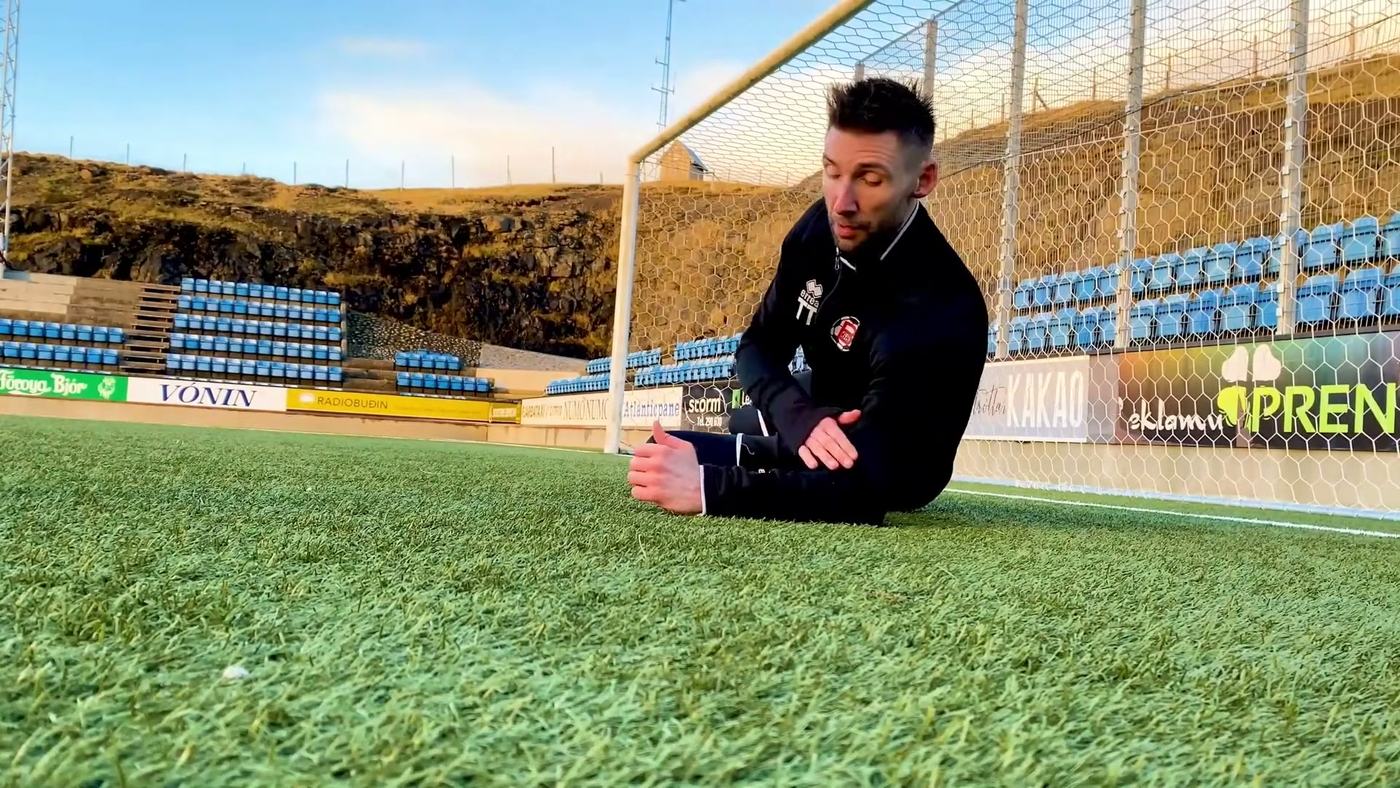
- Seated: glide out sideways, catch the ball in front of your body
- Both sides, more on the weak one
- From your knees
- From a power step
- Full dive
Sit on the ground with the ball in your hands. Glide out sideways with it and catch it in front of your body. Arms in front, bottom hand as close to the ground as you can get it. One hand on top of the ball, one behind. That is it. No height, no impact.
You can do all of it alone. A partner rolling or shooting makes it better, but you do not need one to start. The same progression, with the push-out cue that makes it click, is in the low dive guide.
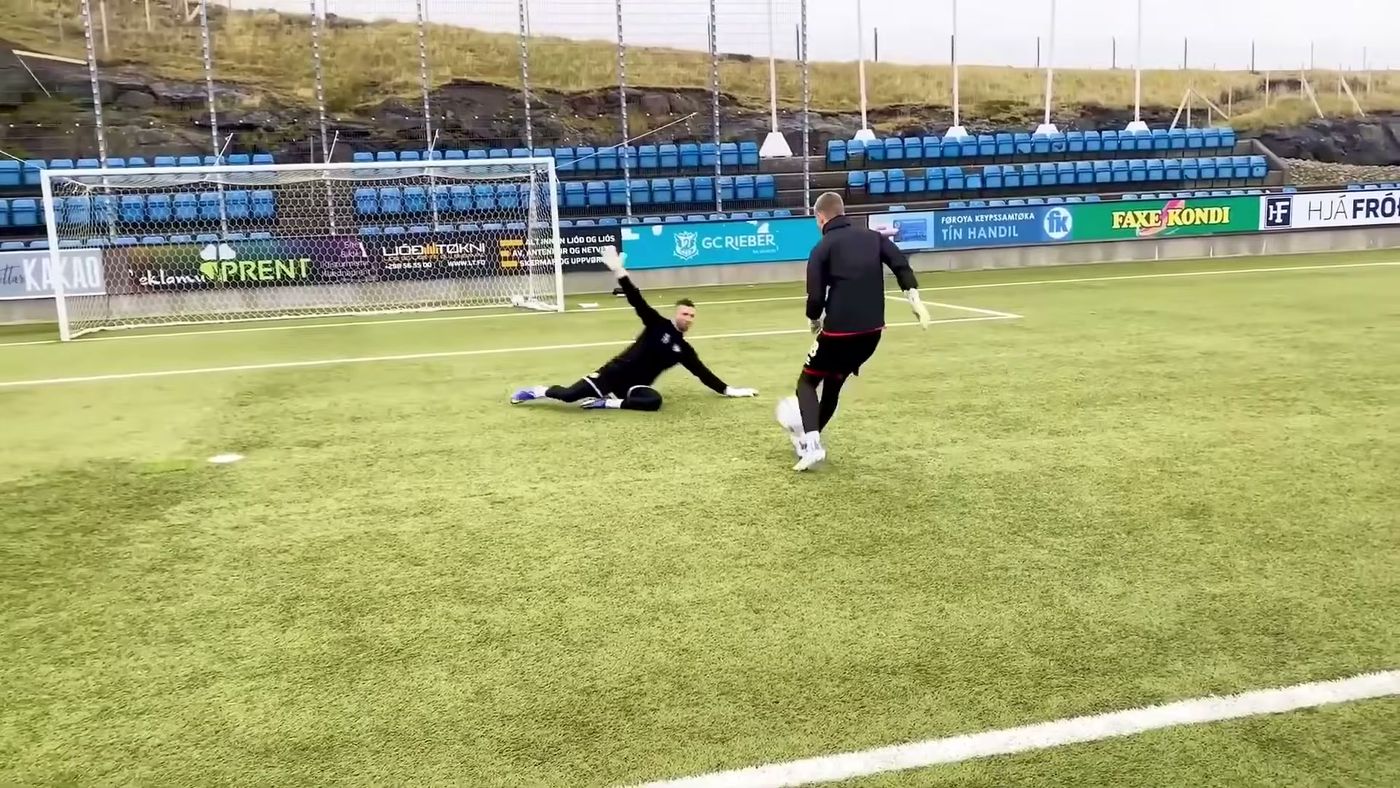
The reason this works is that you are teaching your body the ground is safe before asking it to trust you at height. Bravery is not the missing ingredient. A landing your body believes in is.
What to do this week
One thing only.
Write down what you are actually afraid of
- Specifically. Then one level deeper: why.
- That is the whole task. Not fixing it. Just naming it.
Almost every goalkeeper I have coached who was struggling had never once put it into words. The moment they did, it stopped being a fog and became a list, and a list can be worked through.
If you are somewhere near where I was at 23, please talk to someone about it. A coach, a parent, or someone qualified. I lost years to trying to handle it on my own, and the thing that finally helped me was sitting down with a psychologist who knew what he was doing.
Fear and confidence are the same subject from opposite ends. For the practical side of it, here are three ways to build goalkeeper confidence.
Confidence follows competence
Most of what is above you can start tonight. What is harder alone is the technical side, because confidence follows competence, and competence needs a plan.
That is what the Ultimate Self-Training Course gives you: 120+ drills in a weekly plan, so you always know what you are working on and why. $27 a month.
Have a look at the program 30-day money-back guarantee if it is not helping.
I quit football at 23 and came back. Since then: more than 500 competitive games, my national team, Champions League and Europa League qualifiers, Goalkeeper of the Year several times. I have coached more than 1,000 goalkeepers, and fear is the thing most of them arrive with.
Enjoyed this article?
Find more great content here: