
How to Deal With Crosses Without Panicking
Where to stand, when to come, when to stay, and how to claim it without getting hurt. The fear goes once the decision is clear.
Crosses are where goalkeepers get found out.
Not because catching a ball in the air is hard on its own, but because you have to decide, commit, and deal with bodies around you, all in about a second.
Most young goalkeepers solve that by taking a step back and hoping a defender heads it clear. That works until it does not.
Handling crosses starts before the ball is struck. Stand centrally with your body open to the pitch, stay closer to your line for in-swinging crosses and further off for out-swinging ones, then judge the flight for a split second before committing. If you can reach it, attack it with your outside knee up. If you cannot, get back to your line.
Where should I stand before the cross comes in?
Position does more of the work here than hands do.
In-swinging crosses, where the ball curves towards your goal, mean stay closer to your line. The worst outcome is a ball bending over your head into the net behind you.
Out-swinging crosses, bending away from goal, let you step further off your line. But do not get adventurous. You still need to recover quickly if the flight changes, or if the winger decides to shoot instead.
Your job is keeping the ball out, not catching every cross that comes in. Nobody claims them all.
Open your body
This is the detail that changes everything and almost nobody gets told it.

Stand centrally, with your body open and facing the pitch. Not square to the person crossing it.
If you face the crosser directly, moving backwards for a ball to the back post becomes very difficult. Your feet are pointing the wrong way. An open body lets you go forwards or backwards from the same starting position.
When the attacker comes at you instead
If they are inside your box and dribbling towards goal, shift closer to your near post, shoulders facing them.
From there they have three options: shoot, whip a hard low ball across your six-yard box, or try to lift it over you to the far side.
Being at your near post lets you cut out the low pass, which is the most dangerous of the three, and still gives you time to adjust if the ball goes over you.

Do not step too far in front of your post. That costs you reaction time and makes recovering much harder.
Get comfortable with these basics first. Once they are automatic, you can adjust for how you like to play. The wider question of where to stand for everything else is in the positioning guide.
How do I stop being scared of coming for crosses?
Honestly, by accepting you will get it wrong for a while.
When a cross comes in, you have to be decisive. Hesitation is what gets goalkeepers hurt and what gets goals conceded.

It is so much easier to take that little step back towards your line and hope your centre-half wins it. It is comfortable. And every time you do it, you are training yourself to be that goalkeeper.
You will misjudge some. You will jump too early. You will get bumped and land badly. Treat all of it as information rather than evidence that you cannot do it.
If you never come for anything, you never find out what you can actually reach.
I talk through how I got past it myself in an older video, How I Stopped Fearing Crosses.
What is the difference between brave and reckless?
Timing.
Reckless is committing the moment the ball leaves the winger's boot. If you charge towards your near post and the ball is going to the back post, you are stranded and it sails over you.
Backing off too early is the other failure. Now the striker gets to the ball first and you have not even moved.
The answer is a split second of watching. Genuinely a fraction of a second, while the ball is in the air:
- Is it dipping?
- Is it swerving?
- Near post or far post?
- Can I reach it?
Yes, go, fully. No, get back to your line and be ready for whatever comes next.
That one question, honestly answered in the moment, is most of the skill.
How do I actually claim it?
Once you have decided to go:
- Small, controlled steps as the ball travels
- One powerful step to launch
- Outside knee up
- Take it at the highest point, big W behind the ball
- Land on both feet
- Shout "keeper", early

Start with small, controlled steps as the ball travels. This builds your momentum and lets you adjust your timing as the flight develops. Big strides early lock you into a path you cannot change.
Then one powerful step to launch yourself up.
Outside knee up. It protects you from anyone arriving at the same time, it helps your balance, and it genuinely adds height to your jump.
Take the ball at its highest point. Hands stretched high, fingers spread wide in a big W behind the ball, the same W catch you use for any ball above chest height.
Land on both feet. This is a boring detail that saves ankles. Landing on one foot after contact in the air is how goalkeepers turn ankles.
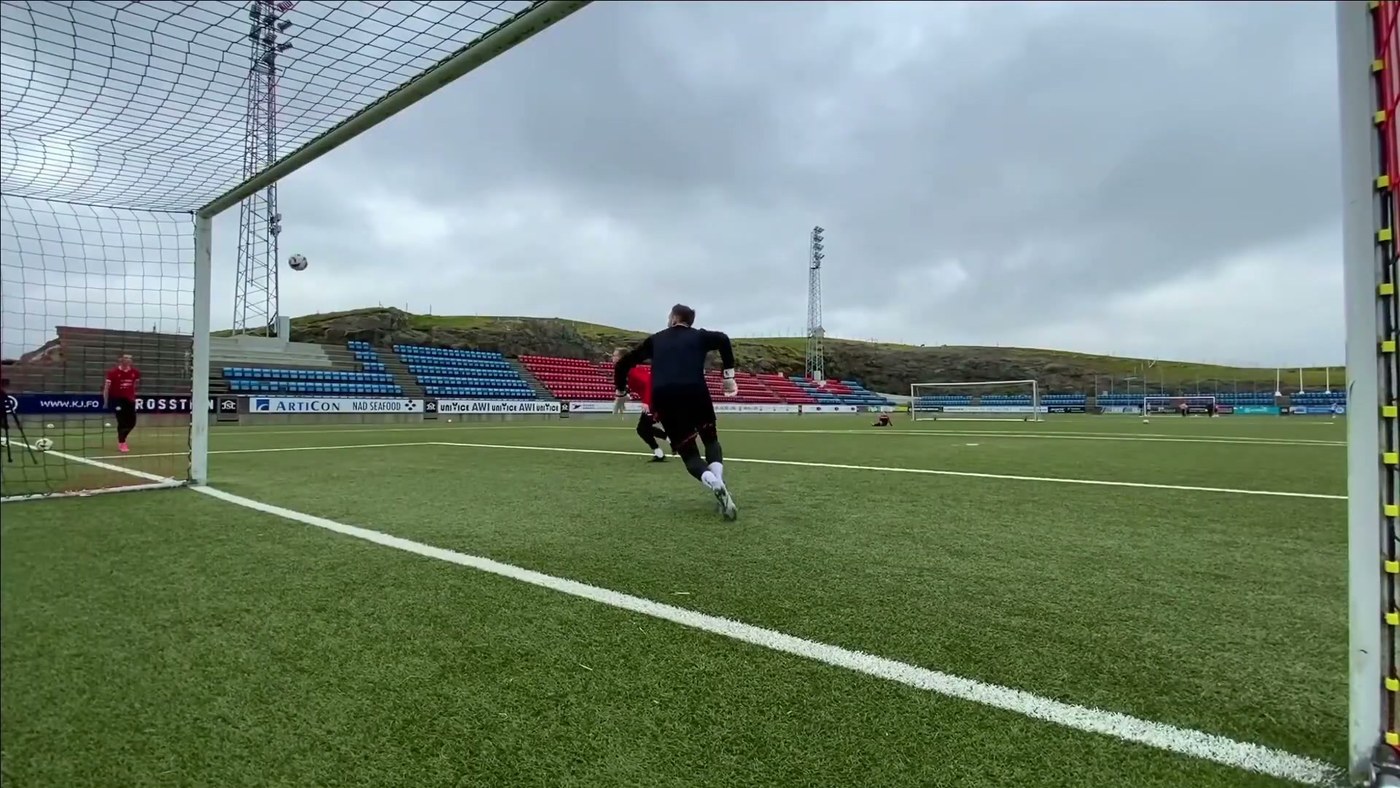
Shout. A loud, clear "keeper" tells your defenders you are coming, and stops the collision before it happens. Say it early enough to be useful.
Not every claim is going to be pretty. Sometimes you wrestle. Sometimes the right answer is a punch. And when the ball is close to your goal with no space to run into, exploding off two feet is often better, because it gives you control and balance even though you get less height.
When should I punch instead of catch?
When catching is risky or impossible. Crowded six-yard box, a wet ball, a cross you can only just reach.
Catch whenever you can. A punch keeps the ball alive, and alive means someone else can score with it.
The one-handed punch
Use your non-punching hand to create space and protect yourself, and to help your balance and guide you to the ball.
Make a solid fist and hit it with your knuckles.
The mistake every beginner makes is trying to hit it as hard as possible. That is harder to time and gives you no control over where it goes.
Instead, use the pace already on the ball. Extend your elbow and punch cleanly, aiming to send it high. You want it out of the danger area, not out of the stadium.
This one is best when you need to move the ball from one area to another.
The two-handed punch
For fast crosses coming straight at you.

Bring both fists together into one wide, solid surface, knuckles facing out.
Before you punch, keep your hands near your chest with elbows at your sides. That gives you control and loads the movement.
Then punch through it, using your core and back rather than just your arms.
More power and a bigger surface, but it limits your mobility, so it works best when you can attack the ball and send it back the way it came.
How can I practise crosses on my own?
You do not need a winger. Most of what makes crosses feel natural is tracking a ball in the air and taking it at the highest point, and you can train that with one ball.
- Throw it high, catch it at the top
- Lie down, toss, roll, stand, catch
- Toss, burpee, catch
- Throw it behind you, recover, catch
- Juggle it with your fists
Throw it straight up and catch it as high as you can. The higher you throw, the harder the timing. When that gets easy, kick it up instead.
Lie on your back with the ball. Toss it up, roll forward, pop up to your feet and catch it at the highest point. It feels awkward at first, and that is the point. It trains your balance and your timing together.
Toss it up, drop into a burpee, get up fast and catch it high.
The back post. Start in the middle of your goal, throw the ball backwards over your head towards the far post, then move back, track it and catch it. You will hate it for the first few goes. It is exactly the movement a deep cross asks for.
For punching, juggle the ball with your fists: left, right, left, right. Then kneel around the six-yard line, spin the ball up so it bounces back towards you, and punch it into the net with both fists and your body behind it.
The jump itself gets stronger with the jumping and leg power drills in the drills library.
What to work on this week
Do not start with catching crosses. Start with where you stand.
Position first, decision second, catching last
- This week: body open, facing the pitch, every time a cross comes in. Not square to the crosser.
- Next week: the split-second decision. Can I reach it, yes or no. Practise being decisive either way, including committing to going back to your line.
The catching improves on its own once the position and the decision are right.
Half of dealing with a cross is what you shout before the ball comes in. And if someone has told you that you are too small to come for them, read how to be a great short goalkeeper first.
Are your hands ready for when you do get there?
Crosses are a lot easier when your handling is already reliable, and that comes from work you do on your own long before match day.
The Ultimate Self-Training Course lays that out: 120+ drills with a weekly plan, so you always know what you are working on. $27 a month.
Have a look at the program 30-day money-back guarantee if it is not helping.
I have played more than 500 competitive games, represented my national team, and played in Champions League and Europa League qualifiers. I have coached more than 1,000 goalkeepers, and crosses are the thing most of them were quietly avoiding when they arrived.
Enjoyed this article?
Find more great content here: