
Goalkeeper Catching Technique: How to Hold Everything
The W catch, the basket and the scoop: which one to use at each height, and the wall drills that make each one stick.
Watch a good goalkeeper catch a hard shot and it looks like nothing. Ball arrives, ball sticks, done.
I used to think that was just talent you either had or you did not.
It is not. It is three techniques, and each one is for a different height of ball. Once you know which is which, catching stops being luck.
Goalkeepers use three catching techniques by height. The W catch for anything chest height and above, the basket catch for mid-height balls, and the scoop for low ones. All three need soft hands, bent elbows to absorb the pace, and your body moved behind the ball.
Does your set position really matter that much?
Yes, and it is where most bobbled catches actually begin.
Ever spilled one and not understood why? You were probably off balance before the ball was struck.
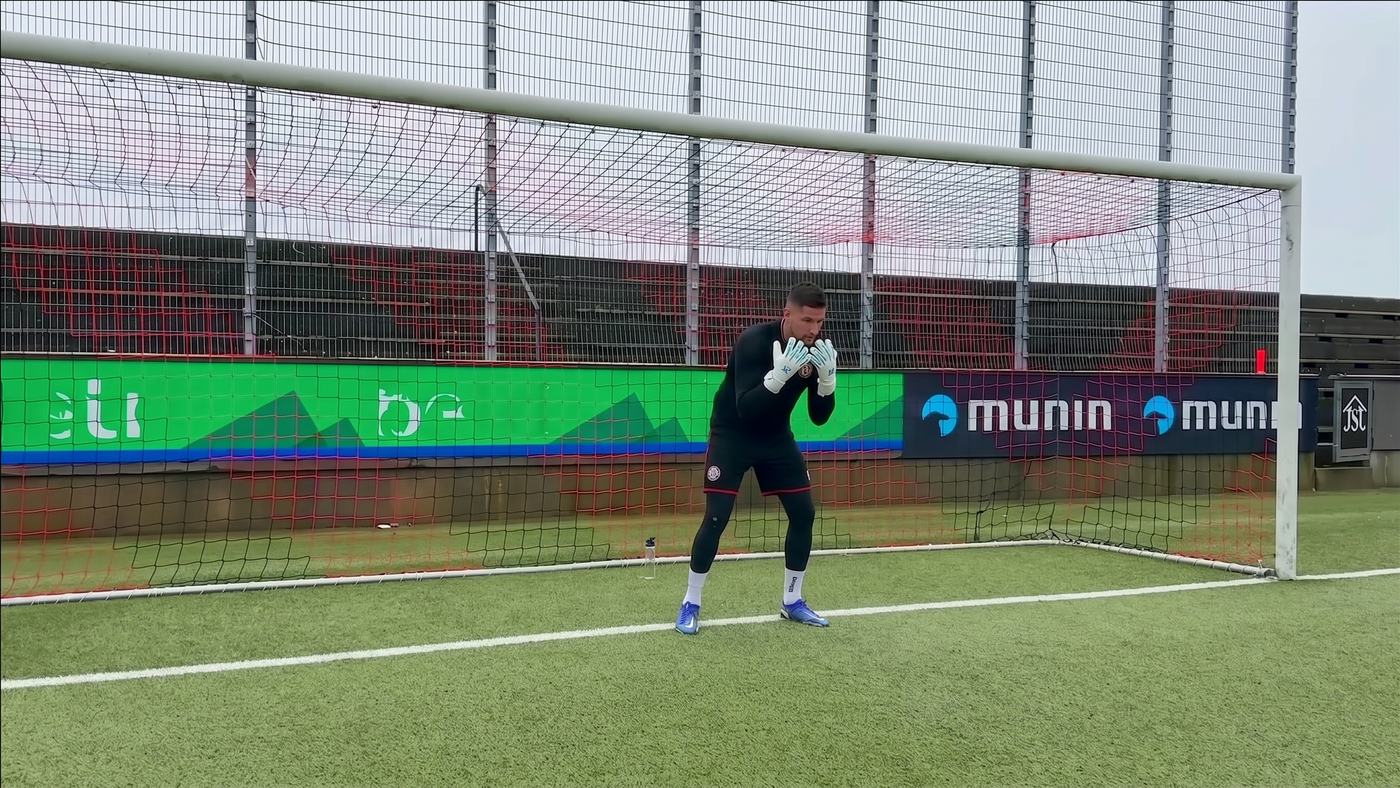
Four things:
Balance. On the balls of your feet, not flat-footed and never leaning back. Leaning back gives you a slow dive and sometimes a face full of your own net.
Soft knees. Bent, never locked. Wide enough that you are stable, narrow enough that you can move. There is no single correct stance, so find what feels right for you.
Relaxed hands. Tense hands mean a tense body, and a tense body cannot catch. Breathe out. Let them hang ready.
Lean in. Attack the ball rather than waiting for it to arrive. Weight forward.
Everything below only works from here.
How do you catch a shot above chest height?
This is the W catch, and you will use it more than any other. Shots at your chest and above, crosses, and diving saves that are off the ground.

Arms out in front with a slight bend at the elbows. Do not cradle the ball into your chest, because that limits your movement and makes it easier for the ball to pop loose.
Make a big W with your thumbs and index fingers. A wide triangle behind the ball gives you the biggest possible catching surface.
If your hands are still growing, bring your thumbs and index fingers closer into a smaller triangle instead. It is the same idea, just easier to hold together with smaller hands, and you can move to the full W as they grow.
Elbows about shoulder-width. Too wide and gaps open up. Too narrow and the ball squeezes out.
Catch the top half of the ball. If you do spill it, or the shot is too powerful to hold, catching high makes it drop straight down at your feet where you can gather it. Catch the bottom half and a spill goes up and away from you.
Let your elbows absorb it. Bent elbows give as the ball arrives and take the pace off. Never meet hard with hard, or it bounces straight back into play.
Think about catching a raw egg, not a rocket. Soft hands only work if your gloves still grip, so if the latex has gone smooth, here is how to make your goalkeeper gloves sticky again.
Eyes on it the whole way, from the moment it leaves the boot to the moment it is in your hands.
And whenever there is time, move your feet to get your body behind the ball. Then even a bad catch hits your chest instead of the net.
Drills for the W catch
You need a wall and a ball. The same wall is also the best reflex trainer you have, and those drills are in how to improve your goalkeeper reflexes.
- Start on your knees. Throw the ball against the wall and catch the rebound. Being on your knees removes your legs from the equation so you can only think about your hands
- Make it harder by moving closer or throwing harder
- Stand up and kick it against the wall for real pace
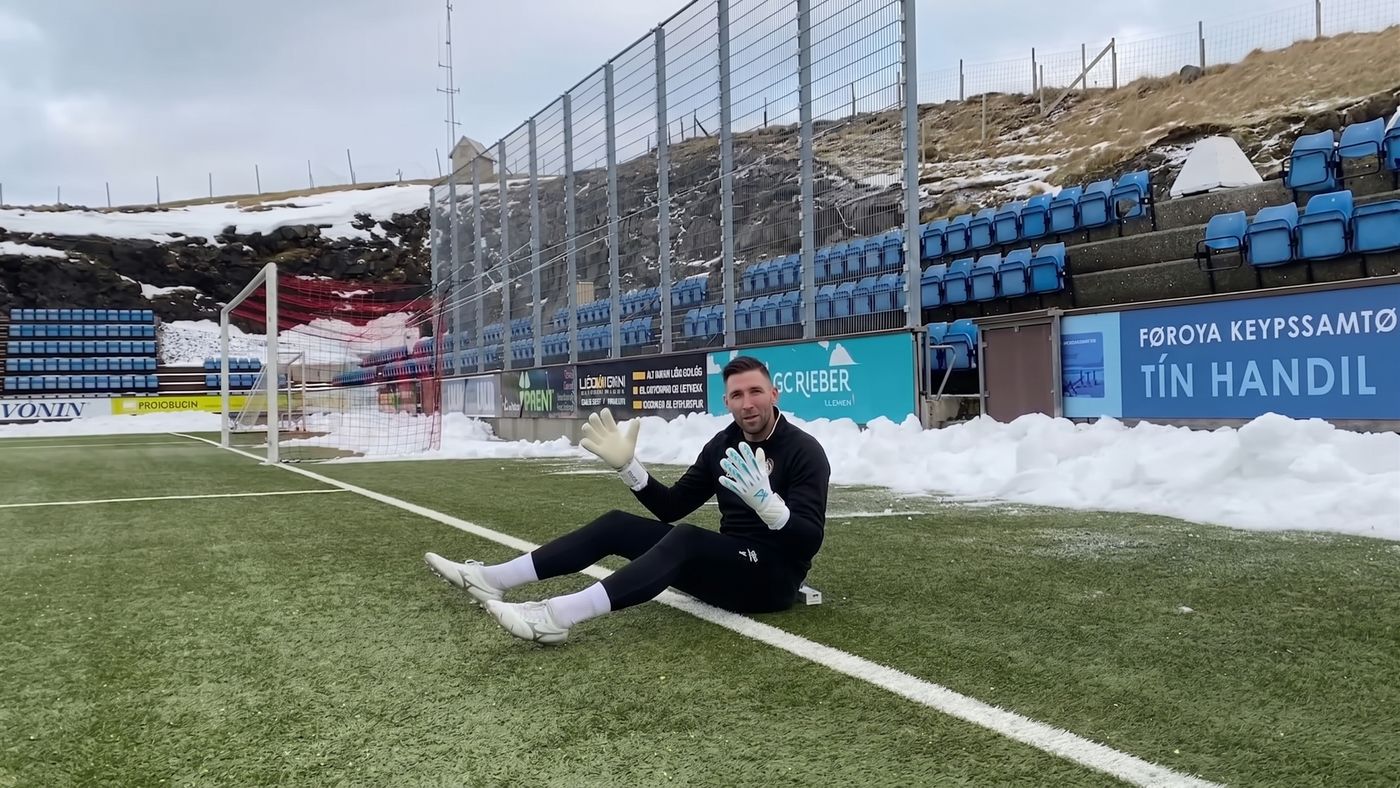
With a partner, work up through the positions:
- Lying on your stomach, partner rolls or passes, you lift your hands and catch
- Sitting
- Kneeling
- Standing
Each stage adds a bit more body. Starting flat on the floor sounds silly, and it is the fastest way I know to fix a technique problem, because you cannot cheat it with your legs. You can watch the whole progression in my older beginner video, Goalkeeper Catching Basics Made Easy.
In training, try to catch everything, even the shots you would parry in a match. It builds the reach for the catch, so in games you hold balls you used to push away. Parrying in training is one of the five habits I see costing young goalkeepers most goals.
What about balls at mid height?
Mid-height balls, around waist to lower chest, are the awkward ones. Too low for a comfortable W, too high to scoop.
This is the basket catch.
Start in your set position, hands in front. As the ball comes, lower your body and reach out, eyes locked on it.
Form a basket with your fingers spread wide for the biggest surface you can make.
Lean slightly forward. This is the bit people miss. Leaning forward opens up space between your forearms and your stomach, which is where the ball is going to land. A little nest for it to drop into.
Keep your elbows close together so it cannot slip between your arms.
Once it is in, bring it to your chest and tuck your chin down over the top to lock it in.
If your momentum carries you forward, do not fight it. Go with it and use your body to shield the ball on the way down.
The golden rule is the same as always: use your feet to get your body behind the ball. Reaching out sideways with your arms wide is how mid-height balls end up in the net.
Drills for the basket catch
On your own: back to the wall, on your knees, then build up. Or hold the ball out, drop it, and basket-catch the bounce. The higher you drop it from, the harder the timing gets.
With a partner: have them throw or kick mid-height balls from different angles and distances, then add bouncing ones. A bouncing ball is much closer to what actually happens in a game.
The basket catch comes down to two things. Body behind the ball, and timing the basket. Get those and mid-height shots stop being frightening.
How do you stop the ball rolling under you?
The one every goalkeeper has lived through. Low shot, takes a small bounce, goes straight through your legs.
The answer is the scoop.

It uses similar hands to the basket catch, with lower body added to secure the ball near the ground.
Widen your stance slightly to make space, then squat and get low.
Extend your arms with your elbows and little fingers close together, making a scoop that guides the ball into your chest.
If your momentum takes you forward, go with it and land softly rather than bracing against it.
For a really powerful low shot, you can stop the ball with strong hands first, kill the pace, and gather it afterwards. That is safer than trying to scoop a rocket cleanly.
The knee barrier
There is a second version, the knee barrier, sometimes called the K scoop. You drop one knee in behind your hands to build a wall.

It is more secure, and for beginners it is a good habit, because the ball has almost nowhere to go.
It is also slower. It needs better reaction time, and if the ball takes an awkward bounce or a deflection after your knee is down, getting back up to adjust is hard. Point your knee towards where the ball is coming from, never square.
Learn both. The standard scoop is faster and more flexible. The knee barrier is safer when you have time. Knowing which to use, and when, is the actual skill.
Whichever leg position you use, your arms are still doing the real work. Elbows and little fingers close together.
Drills for the scoop
On your own: wall again, on your knees first to isolate the arms, then harder kicks, then bouncing balls.
With a partner: kneeling with them rolling or passing, then standing, then varied shots, then bounced ones so you have to deal with an unpredictable bounce.
What to work on this week
Pick the height that keeps beating you.
Catching is a whole chapter in my free Goalkeeper Technique Playbook. Every technique gets one page: when to use it, the steps, the mistake I see most, and a drill to do on your own.
One height. One week.
- Shots popping out of your chest? W catch against a wall, on your knees, for a week.
- Balls squirming through at waist height? Basket catch, and pay attention to leaning forward.
- Things going under you? Scoop work, starting with the knee barrier until the ball stops getting through.
Ten focused minutes against a wall, three times a week, will do more for your handling than one long session at the weekend. Hands learn through repetition, not through effort.
Catching a ball served at you is one thing. Catching a cross with three players around you is another, and the hand shapes here are what it is built on. The rest of the handling work is in the drills library.
Which technique should you work on first?
A wall and a ball will take you a long way. What it will not tell you is which technique to prioritise, or what to move on to once your handling is solid.
That is the job the Ultimate Self-Training Course does: 120+ drills in an order that makes sense, with a weekly plan already written. $27 a month.
Have a look at the program 30-day money-back guarantee if it is not helping.
I have played more than 500 competitive games, represented my national team, and played in Champions League and Europa League qualifiers. I have coached more than 1,000 goalkeepers, and most of their handling problems started in the set position, not the hands.
Enjoyed this article?
Find more great content here: