
How to Make Your Goalkeeper Gloves Sticky Again
Your gloves are probably dirty, not finished. How latex grips, how to wash and dry a pair properly, and which grip hacks wreck them.
Your gloves used to hold everything. Now the ball squirms out of catches you would have held a month ago.
The gloves probably are not finished. They are almost certainly just dirty.
Before I start, something you should know: I co-founded a goalkeeper glove brand called Rectrix with my business partner in the UK. So I am not a neutral voice on gloves. What follows is how latex actually works, and most of it will save you money rather than make me any.
Goalkeeper gloves grip through microscopic pores in the latex. Those pores clog with dirt and sweat, which is what kills your grip. Wash them in lukewarm water with a mild soap or glove wash, air dry them out of sunlight, and dampen them before you play. That restores most of the grip people think they have lost forever.
Why do gloves lose their grip?
The palm of your glove is latex, and latex grips because its surface is covered in tiny pores. Those pores create friction against the ball.
Two things follow from that, and they explain almost everything about glove care.
Wet latex grips better than dry latex. Moisture opens those pores up. That is why you see goalkeepers spitting on their gloves or splashing water on them before kick-off. It is not superstition, it is the material working properly.
Clogged pores do not grip at all. Dirt, sweat, grass and dust fill them in. Once they are full, the surface is effectively smooth, and smooth does not grip.
So when your gloves "go dead", they usually have not worn out. The pores are blocked. Clean them out and a lot of the grip comes back.
So yes, a good pair is meant to feel slightly sticky. If yours feel smooth and slippy even when damp, they are telling you they need a wash.
How to wash goalkeeper gloves
This is the whole maintenance routine, and it takes five minutes.
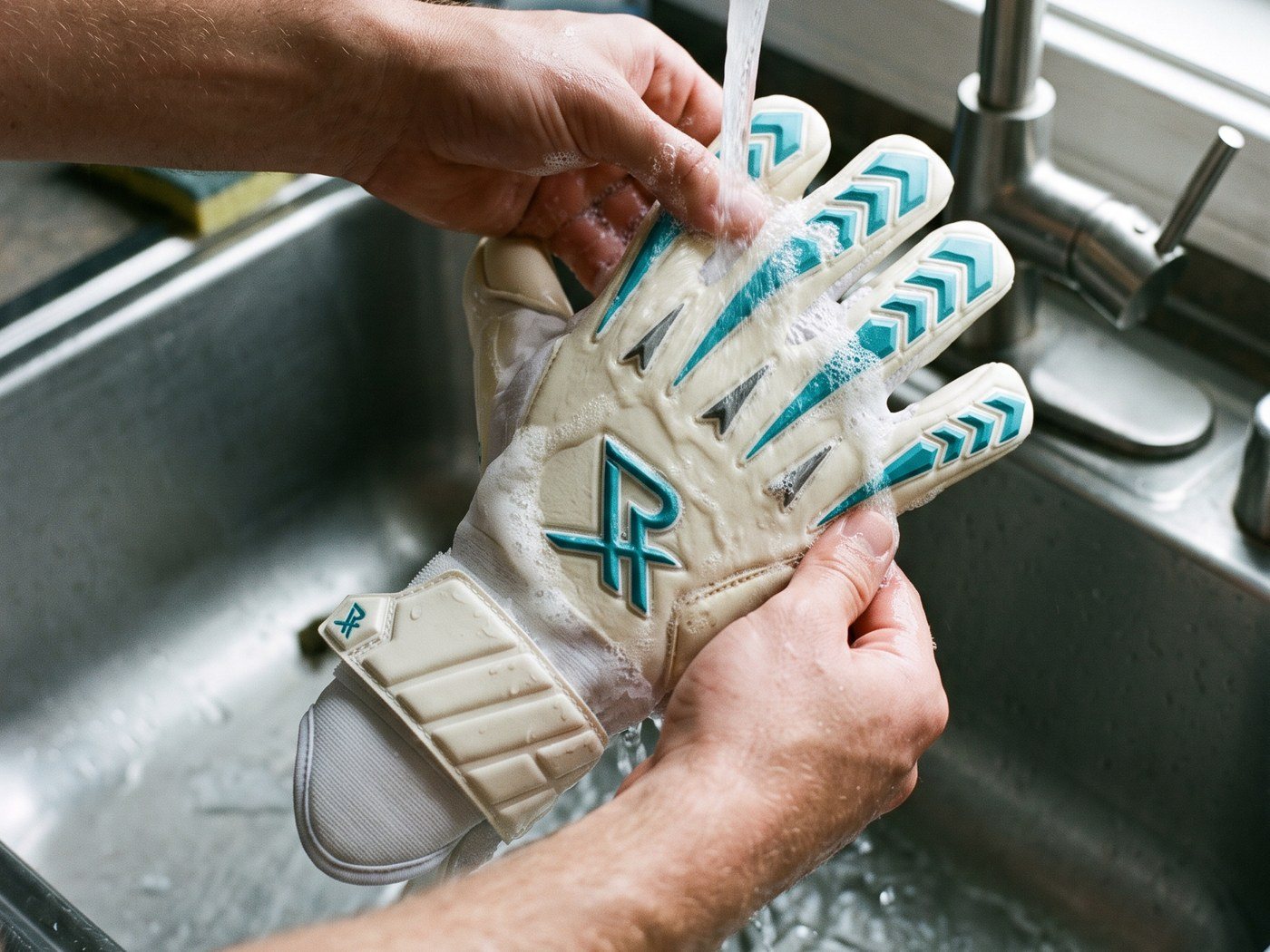
- Lukewarm water, never hot
- Mild soap, or a proper glove wash
- Rub gently, never scrub
- Rinse properly
- Press flat between two towels, never wring
Lukewarm water. Never hot. Heat damages latex and permanently reduces grip. If it is too warm for your hands, it is too warm for your gloves.
Mild soap, or a proper glove wash. Ordinary laundry detergent is harsh and dries the latex out. A dedicated glove wash is designed to get into the pores without stripping them.
Rub gently. Do not scrub. Scrubbing wears the palm, which is the part you actually need.
Rinse properly. Leftover soap sits in the pores and does exactly what dirt does.
Never wring them out. Twisting damages the latex and ruins the shape. Press them flat between two towels instead.
Wash them after every few sessions, not once a season. That single habit will do more for your grip than any spray you can buy.
How to dry them
This is where most gloves get killed, and it happens at home rather than on the pitch.

Air dry only.
Keep them out of direct sunlight. UV breaks latex down. A sunny windowsill will finish a pair of gloves faster than a season of matches.
Never on a radiator. Ever. Heat makes latex crack, and cracked latex does not come back. If your gloves are soaked and you have training tomorrow, that is what a second pair is for.
Lay them palms open so they dry evenly and do not stick to themselves.
Somewhere ventilated, otherwise you get mould, which is both grim and bad for the latex.
How to store them

Cool and dry. Not a damp kit bag left in the boot of a car.
Not squashed under anything heavy, which wrecks the shape.
In a glove bag if yours came with one. That is what it is for.
Palms facing each other. This stops the latex touching the Velcro wrist straps, which chews it up over time. Small thing, and it genuinely extends the life of a pair.
Do the grip hacks work?
You will find plenty of these online. Here is my honest read on each, including the ones I would not use.
| Method | Verdict |
|---|---|
| Water | Works, free, and the one to use. Dampen before kick-off and keep a towel to re-wet during breaks |
| Proper glove wash | Works. Cleans the pores without stripping the latex. Worth the money |
| Grip spray | Works short-term. Useful for a big match, not a substitute for washing |
| Rosin powder | Works in humid or sweaty conditions, because it absorbs moisture. Light dusting only |
| Vaseline | Temporary tackiness, and it degrades latex over time. I would not |
| Hairspray | Dries the latex out. Avoid |
| Lemon juice | Sometimes revives an old, glazed pair. Last resort, on gloves you have written off |
| Cola or honey | Messy and attracts every bit of dirt on the pitch. No |
| Fine sandpaper | Very gently, on a glazed old pair, it can expose fresh latex. You are shortening their life to buy a few games |
Notice the pattern. The things that work are cleaning and water. The things that damage your gloves are the clever hacks.
If you are reaching for sandpaper or lemon juice, what you have is a pair of gloves at the end of their life, and no amount of household chemistry is bringing them back.
Grip in different weather

Rain. A wet ball is slippery, but soaked gloves are worse. Dampen them before kick-off, keep a towel to hand for stoppages, and if you can, take a second pair and switch at half time. On a wet day, punching a cross you would normally catch is a proper decision, not a cop-out.
Heat. Sweaty palms reduce grip. Drink properly before and during the game, because dehydration makes you sweat oddly, and choose a glove with real ventilation.
Cold. Cold hands go stiff and stiff hands drop things. A glove with a thermal lining is worth it if you play through winter.
Snow. Clap your hands together regularly to knock the build-up off the palms.
Mud. A muddy ball clogs the pores fastest of all. Wipe your gloves on your shorts or a towel at every stoppage.
When are gloves actually finished?
Wash them properly, dry them properly, and see what you have.
If the palm is cracked, split, or worn through to the backing, they are done. Latex does not repair.
If the palm is intact but shiny and hard, that is glazing, and there is usually some life left. A proper wash often brings a surprising amount back.
Most young goalkeepers throw away gloves that had months left, and play a whole season in gloves that were finished in November. Neither is what you want. Where the money goes matters more than how much of it there is.
One thing worth saying, given that I sell gloves: a clean mid-price pair will out-grip an expensive pair you have never washed. Latex quality matters. It matters less than care.
What to do this week
Wash your gloves tonight
- Lukewarm water, mild soap, gentle.
- Press dry in a towel, palms open, somewhere out of the sun.
- Use them at your next session and see what you think.
Most goalkeepers who do this for the first time are surprised, because they had assumed the grip was gone for good. If they are still dead after a proper wash, the latex has gone, and it is time.
And if it is not your grip holding you back but your handling, that is a training problem rather than a kit problem. The three catching techniques are where to start, and the Ultimate Self-Training Course builds them week by week.
When it is time for a new pair
I would obviously like you to look at ours. Rectrix is the brand I co-founded, built around the grip and durability I wanted as a goalkeeper and could rarely find at a sensible price.
Our new glove is the Rectrix Glory: 4mm German contact latex, a hybrid cut with finger wraps, sizes 7 to 11. I wear it in my own matches. For now it is only sold on Amazon UK, at £54.97. Wash it the way this guide says and it will last you a long time.
Have a look at the Rectrix Glory Rectrix is a brand Kristian co-founded. This is not an affiliate link.
I have played more than 500 competitive games, represented my national team, and played in Champions League and Europa League qualifiers. I have coached more than 1,000 goalkeepers, and I co-founded Rectrix, a goalkeeper glove brand, with my business partner in the UK.
Enjoyed this article?
Find more great content here: