
Goalkeeper Footwork: The Movement Nobody Teaches
The side shuffle, led with the correct leg, and the crossover for covering ground fast. When to use each, and the one rule both share.
You were probably told never to cross your legs in goal.
That advice is half right, and the half that is wrong is costing you saves at your back post.
There are two ways a goalkeeper moves. Most young goalkeepers only ever learn one, and use it badly.
Goalkeepers use two footwork techniques. The side shuffle is your default for moving across goal, always starting with the leading leg and using short sharp steps. The crossover is for covering ground fast, usually one cross step then straight back into a shuffle. Both must finish with you completely set before the shot.
Start from the set position
Everything below fails if this is wrong.

On your toes. Knees shoulder-width apart and slightly bent. Hands in front of your body. Weight forward, leaning just a touch. It is the same set position every dive starts from.
That is your starting point and your finishing point for every movement you make.
How do I side shuffle properly?
This is your go-to. It keeps you balanced, square and ready to go either way.
Three things go wrong with it.
Starting with the wrong leg
If you push off with your trailing leg, your stance immediately becomes too narrow. Get caught in that position when the shot comes and you cannot dive either way. Unless the ball is hit straight at you, you are not saving it.
Always start with your leading leg. Going to your right? Lead with your right leg. Put your weight on the trailing foot, then transfer it onto the leading foot. It sounds small. It is the difference between being able to dive and not.

Steps that are too big
Two big strides feels efficient. It is not. Big steps slow you down, and worse, they leave you unable to push off. There is no power available for a dive from a wide, stretched stance.
Short, sharp steps. Controlled footwork keeps you balanced, and balanced means you can spring in any direction: a dive, a change of direction, or a reaction to something unexpected.
A drill for this: put a resistance band around your ankles and shuffle. It keeps your feet the correct distance apart and makes the muscles work harder, which builds the strength for those quick explosive movements.
Still moving when the shot comes
Ever shuffled so much that you were not actually set when the ball was struck? The rule is simple: when the ball is moving, you move. When the striker has it under control and is ready to shoot, you stop and get set.
Even if that means being slightly out of position. Being set and half a step off beats being perfectly positioned and still moving. A goalkeeper in motion cannot push off. It is the same rule as coming off your line: stopped and set before the strike, every time.
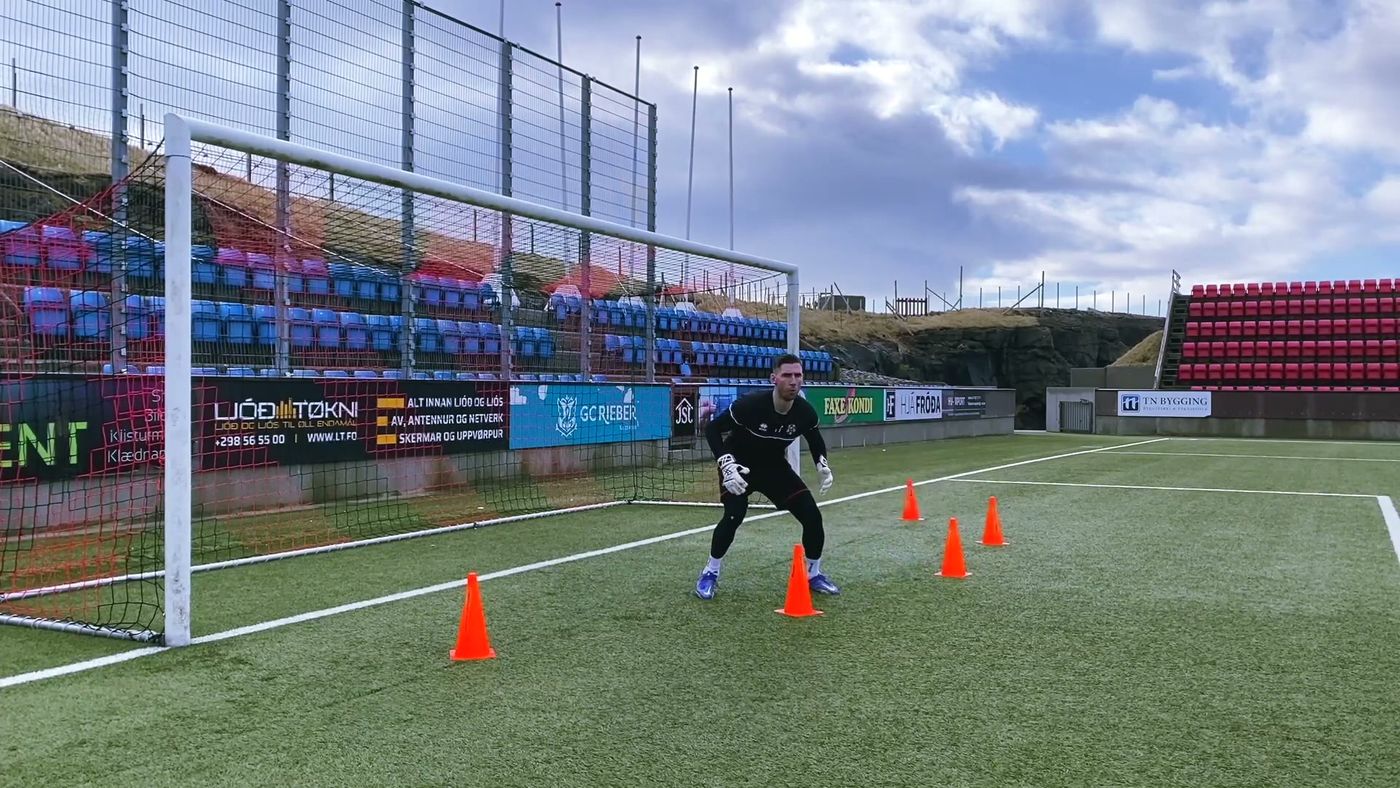
A drill for this: put cones across your goal. Shuffle across, and stop in a proper set position at every single cone.
With a partner, have them dribble inside your box. You follow them, and stop and set every time they look ready to shoot.
When should I cross my legs?
Here is the controversial part.
Picture it. You are perfectly positioned to cut out a cutback or save a shot, and instead the ball is played to your back post.
You have one job: get from here to there, fast.
What most goalkeepers do is turn and run. That almost always ends in an awkward backward dive with you falling into your own goal, having given yourself no chance.
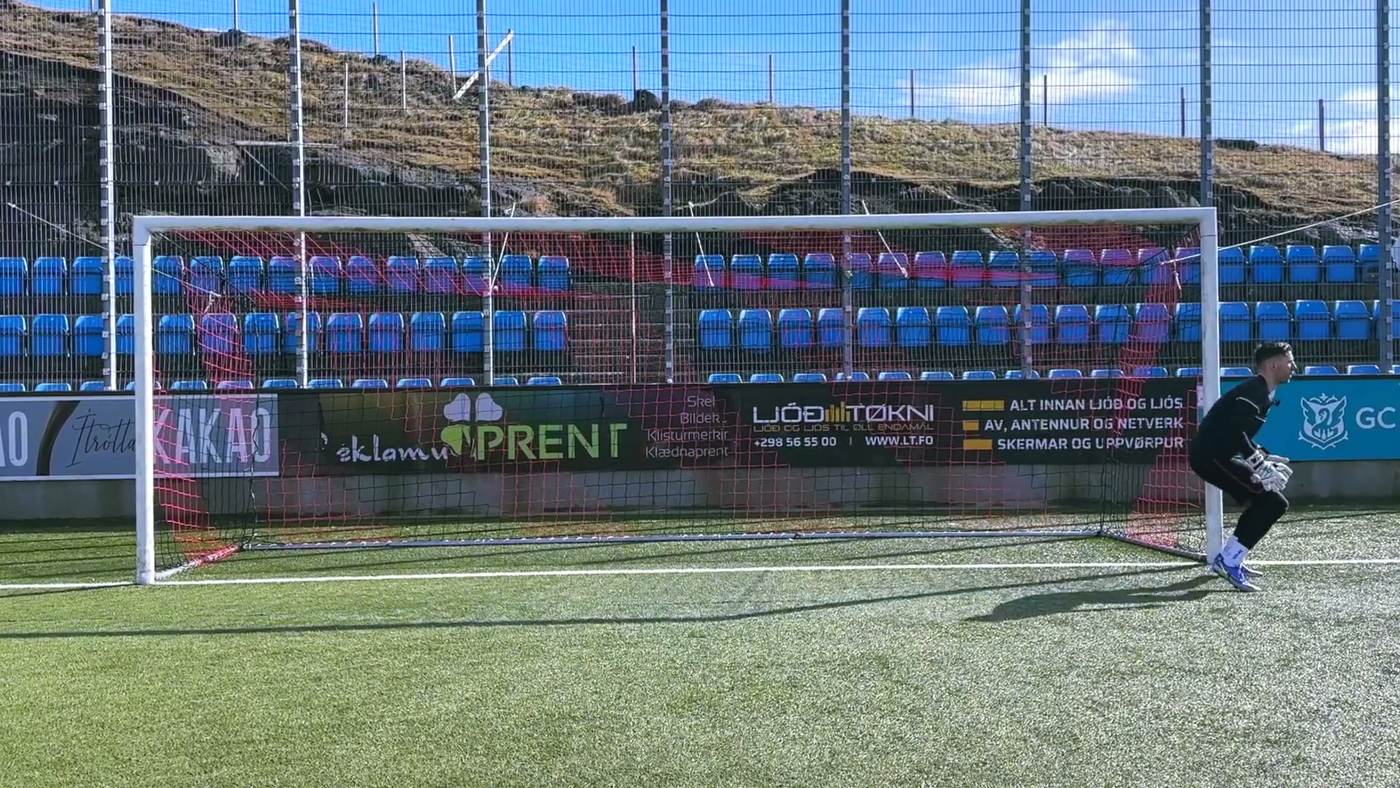
Instead: open your hips slightly and cross step across.
Open the hips, cross step, and you arrive facing the right way, in your set position, able to dive either side or react to another touch.
Compare that with shuffling the same distance. Shuffling is fine, but it is nowhere near as fast.
There is a second situation where the cross step wins. When your goal is gaping and the striker really only has one place to put it, you just need to get as close to the shot as possible before diving with everything you have. Speed is the only thing that matters, so cross step.
Do not cross step all the time. Do that and you will be in trouble, because it leaves you exposed to anything unexpected. If you are moving or leaning one way and the shot goes the other, you are gone. You might get lucky and have it hit you. Eventually the luck runs out.
The answer is a combination. When you need to cover a lot of ground:
- Open your hips
- One cross step to eat the distance
- Transition into your side shuffle
- Stop and set before the shot
Open your hips, cross step, then shuffle. You cover the ground quickly and arrive ready for anything.
A drill for it: set up as though facing an angled shot, then cross step across your goal and back. Once that is comfortable, do the same but transition into the shuffle halfway.
The video at the top runs through five cone drills that build both movements. My older footwork video, Fast Goalkeeper Footwork Techniques Coaches Don't Share, has the resistance band and partner drills from this guide. More footwork drills, sorted by skill, are in the drills library.
Which one should I use?
There is no single right answer in goalkeeping and there certainly is not one in footwork. It is about the right decision at the right moment, and that comes from games and training.
As a rule of thumb:
| Situation | Technique |
|---|---|
| Covering a long distance quickly | Cross step, then shuffle |
| General movement across your goal | Side shuffle |
| Ball being played to your back post | Cross step |
| Striker about to shoot | Neither. Stop and set |

The side shuffle keeps you ready for anything and lets you set quickly. That is why it stays your default.
What to work on this week
Start with the leading leg. That one thing.
- Set up four cones across your goal.
- Shuffle between them, leading leg first every time, short sharp steps.
- Stop in a full set position at each cone.
- Ten minutes. Once that is automatic, add the cross step.
It is dull. It will fix more of your goalkeeping than any diving drill you do this month, because everything else happens after your feet have put you in the right place.
A few cones, and the right order
Footwork is one of those things you can genuinely train alone with a few cones, as long as you know what you are practising and in what order.
The Ultimate Self-Training Course lays that out: 120+ drills with a weekly plan covering footwork, handling, diving and distribution. $27 a month.
Have a look at the program 30-day money-back guarantee if it is not helping.
I have played more than 500 competitive games, represented my national team, and played in Champions League and Europa League qualifiers. I have coached more than 1,000 goalkeepers. Nearly every one arrived pushing off the wrong leg.
Enjoyed this article?
Find more great content here: