
5 Goalkeeper 1v1 Mistakes That Cost Goals (and the Fix for Each)
Glued to your line, rushing out, the wrong technique, a twisted chest, and the gap between your legs. Five 1v1 mistakes, and what the best keepers do instead.
Ever watched a top goalkeeper shut down a 1v1 like it was nothing and thought, how did he make that look so easy?
It is not luck, and it is not some superhuman gift. Most goalkeepers just make the same small mistakes in 1v1s over and over again.
If you are tired of guessing, diving early, or getting caught in no man's land, these are the five, and how to fix each one.
The five goalkeeper 1v1 mistakes that cost goals: staying glued to your line so the striker gets a head start, rushing out when waiting would win, picking the wrong technique for the distance, twisting your body away from the shot, and leaving a gap between your legs for the nutmeg.
Are you glued to your line?
You read a through ball perfectly, sprint off your line, and somehow the striker still gets there first. Then you watch an older, slower keeper deal with the exact same ball like it is nothing. It feels unfair.
That is what I was thinking watching a wild 3-3 between Barcelona and Inter in the Champions League. The moment that stood out for me was not a goal or a save. It was Barcelona's goalkeeper shutting down three 1v1s without making a save at all.
He is not 21 any more. He is not sprinting off his line like a young Neuer. He just started higher, stayed connected with his back line, and read the danger early.

That is the real secret. When you stay glued to your line, you give the striker a head start and you turn a simple through ball into a desperate 1v1. When you stay connected with your defenders, moving up when they move up and adjusting to where the ball is, you step forward early and you do not need to make the save, because you stop the shot from ever happening.
Where exactly to stand as the ball moves up and down the pitch is in the 1v1 guide, and the mistake of dropping deep when your defence pushes up is in positioning mistakes.
Are you rushing out when you should wait?
So now you start a bit higher and you read the game. Good. But a new problem shows up as soon as your positioning improves, and at first it does not even look like a mistake.
Champions League again, the semi-final between PSG and Arsenal. Trossard gets played in on the left, a classic 1v1, perfect angle to shoot across the goal. This is where most goalkeepers panic. They charge out, try to make themselves big, and get chipped, dribbled, or just beaten.
Donnarumma saw the angle getting tight, knew Trossard wanted his right foot, stayed calm, waited, and then exploded low to his left for a monster save. Because he did not rush.

Most goalkeepers force the big 1v1 moment. They run out when they do not have to, and they make the striker's job easier. Hold your position, stay balanced and patient, and you flip the pressure, because now the striker has to commit first.
Waiting gives you control, especially when the angle is narrowing or your defenders are tracking back to pressure the striker. Holding your ground is often better than rushing out. It is the same patience that wins penalties.
Are you picking the wrong technique?
You stay patient. You are stood there thinking, I have got this. Then the striker takes another touch, you rush out, and you pick a technique out of panic. Usually the wrong one.
I did exactly this. I did not know which technique to use or when. So here it is, really simple.
Very close, or a tight angle: the block
Not much room to shoot. Stay upright, close every gap, tuck everything in. You are trying to be a wall.
A few steps away and central: the spread
The striker has time and space to pick a corner. The spread simply covers more of the goal.
You can get there first: the smother
Hands first, body behind, and take the contact if you have to.

You do not pick the technique you like most. You pick the one the situation needs. Spread too early and you are begging to be dribbled round. Smother too late and it is a penalty or an open goal. Block from too far away and they pick a corner because you are not covering enough.
Do not guess. Do not default. Adapt. Each of the three, with the distance it works from, is broken down in the 1v1 guide.
Are you twisting away from the shot?
You step out at the perfect moment, make yourself big, and the ball still sneaks past you. I hated that feeling, and I could not work out what I was doing wrong until I watched the replay.
I was not late. I was not out of position. I was twisting my body.
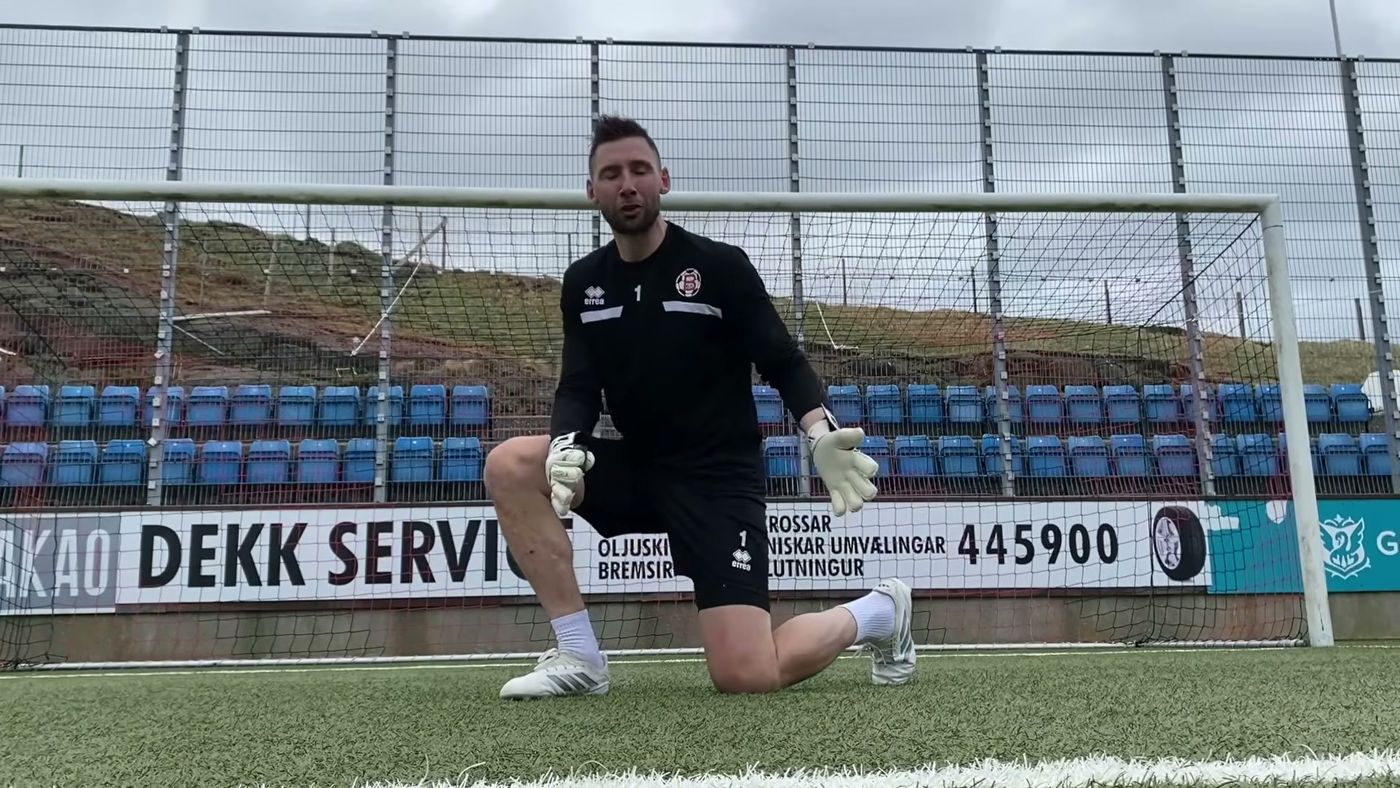
My chest turned away, and that one small movement destroyed my whole shape. Your brain does it to protect you. Nobody likes a shot in the ribs or the nose, so the body turns. It is human.
After 20 years playing at this level, I can tell you that little twist hurts you far more than any shot ever could. Trust your shape and face the shot fully square, chest forward. If you are scared of getting hit in the face, tuck your chin and let the ball hit your forehead. It hurts much less than you think, and much less than a soft goal.
Are you leaving the door open?
What is the most frustrating way to concede a 1v1? Not the chip. Not being rounded. It is the nutmeg. The striker slides it straight through your legs and you feel like a fool.
It really stings, and it is usually your own fault. You left the door open, and strikers love that gap, especially up close where the angle is tight and there is no time for anything fancy.

In the block, keep your shape tight, standing foot close to your heel. In the spread, the lower you go, the harder that gap is to find. It takes flexibility, reps and discipline, and it is worth every rep. You can do 99 things right in a 1v1, and if you leave that one gap open, you are beaten.
What to do this week
Want the right version of each save on one page? The smother, the block and the spread are all in my free Goalkeeper Technique Playbook, with a drill for each one.
Most 1v1s are lost by a decision, not a lack of talent.
- Next game, count how many times you step up with your defenders instead of hanging on your line.
- In every 1v1, wait one beat longer than feels comfortable before you commit.
- Say the technique out loud in training before you use it: block, spread, or smother. Distance decides.
- Film yourself. If your chest turns, you will see it in one clip.
Position first. Then patience. Then the right shape.
Getting to the right spot in time is footwork, and the drills that train all of this alone or with a partner are in the drills library.
Do you know what to train after 1v1s?
Position, patience, technique, shape. The order you train them in is the difference between improving and just being busy.
If you want a full self-training programme that actually works, with the structure and the drills in the right order, that is the Ultimate Self-Training Course: 120+ drills in a weekly plan, 1v1 work included. $27 a month.
Have a look at the program 30-day money-back guarantee if it is not helping.
I have played more than 500 competitive games, represented my national team, and played in Champions League and Europa League qualifiers. I have coached more than 1,000 goalkeepers, and the twist away from the shot is the 1v1 mistake I had to unlearn myself.
Enjoyed this article?
Find more great content here: