
Goalkeeper 1v1 Techniques: How to Do Each One Properly
The smother, the spread save, the K save and wait and react. How to do each one, step by step, and where each one leaves you open.
You read the 1v1 right. You sprint out, you go down, and the ball still ends up in the net. Or worse, the referee points to the spot.
Most of the time the decision was fine. The technique let you down: a hand in the wrong place, a body turned away, a leg that would not go down far enough.
So this one is about the how. Four 1v1 techniques, step by step, with what each one is good at and where it leaves you open.
There are four goalkeeper 1v1 techniques: the smother, the spread save, the K save and wait and react. The smother slides you onto the ball or through it. The spread goes all the way down and covers the most goal. The K stays half up and keeps you in control. Wait and react is the one you use most.
How do you do the smother save?
Some coaches call it the Superman, and you can see why. You go down on your side and slide forwards towards the ball, either to win it or to block it.
As goalkeepers we want to be proactive, and the smother is perfect for that. It is done at high speed. You sprint at the ball and throw your body in front of the striker's feet.
It fits through balls, a failed offside trap, or a striker who breaks away from your defenders and takes a heavy touch.
When you can get there first:
- Sprint at the ball, do not jog
- Go down on your side and slide forwards
- Hands out in front of your body
- One hand behind the ball, one on top
- Head behind the ball
- Gather it and hold on

The head goes behind the ball, not beside it, because the ball protects your face.
What if the striker is going to get there first?
You are on your way and you can see you will not reach it in time. Do not stop. Stopping halfway is the worst place to be.
Keep going and go through the ball with your stomach. Now you are blocking, not catching. Spread your hands so the striker has nowhere to go but into your body, and come with real force.
Keep your top hand up, above your body. A lot of strikers will try to chip you here, and that hand is your answer to it.

Neelu, one of the goalkeepers I coach, opens her highlight video with a 1v1 smother. In her words: "I really feel like that shows that I'm a confident and aggressive goalkeeper." That is what a good smother says about you.
If your timing is off, you end up too far from the striker. One touch round you and you can give away a penalty. And the smother is not great against a chip. The top hand saves a lot of them, but it does not cover the whole goal.
You can use it anywhere in the box, as long as the timing is right. How to tell when you will get there first is in when to use the smother save.
How do you do a spread save?
The spread save is what it sounds like. You spread yourself as much as you can so the ball cannot get past you.
- Get as close to the striker as you can
- Wait until he is going to shoot
- Go all the way down, as wide as you go
- Chest to the ball, never turned away
- Head down a little
Why head down? If the striker blasts it at your face, you want it on your forehead, not your nose. Off the forehead it does not hurt.
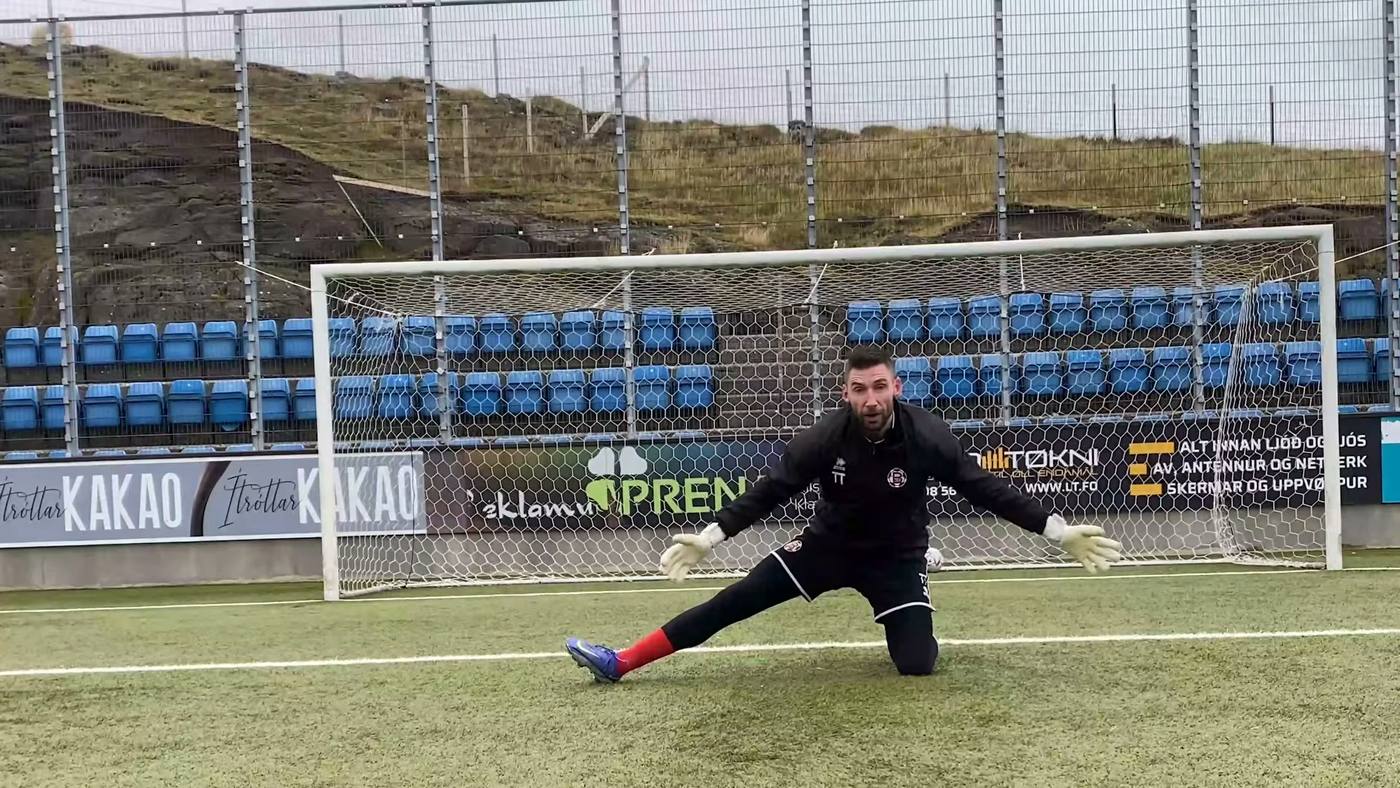
It takes a lot of flexibility. I am not a young goalkeeper any more, and my flexibility is not what it used to be. I only really get down properly on one side. On the other side my leg does not go nearly as far.
So if you want this save, train your mobility. The routine I use myself is in goalkeeper stretches: the 12-minute routine.
Use it in the middle of the goal. Think of a shot that hits your defender and suddenly drops to the striker in front of you. Rush out, spread yourself and make sure he has to shoot.
You are fully committed, so there is no way back. If he takes a touch round you instead of shooting, you have no chance. You are open to shots between your legs, and if you are not flexible it covers much less than it should.
The quickest way to waste a spread is to turn your body away as the shot comes. Why your body does that, and how to stop it, is in the 1v1 mistakes that cost goals.
How do you do the K save?
This one is a personal favourite. It is also called the block save, and you stay half up instead of going all the way down.
- Get as close to the striker as you can
- Drop onto one knee
- Plant the other foot
- Front knee bent to about 90 degrees
- Hands out wide, the shape of a K

It only works up close. Try it from far away and the goal is gaping beside you. Get really close and the striker has nowhere to go but into your body.
It is at its best from the side. The goal is smaller from there, and the tighter the angle gets, the better the K works, because you cover a lot of a narrow space.

It does not cover as much as the spread. But you are far more in control, because you are not committed. If he tries a chip, you still have time to get your hands to it. You are not as open between your legs. And if he tries to dribble round you, you can still block him with your leg.
Which leg to lead with, and how to stay compact with no gaps, is in when to use the block save.
What is the wait and react technique?
This is the one you will use most. And it is the one young goalkeepers forget is a technique at all.
We do not want to force a 1v1, especially when we cannot win the ball. Most of the time you stand in your goal, react to what happens and see what the striker does.
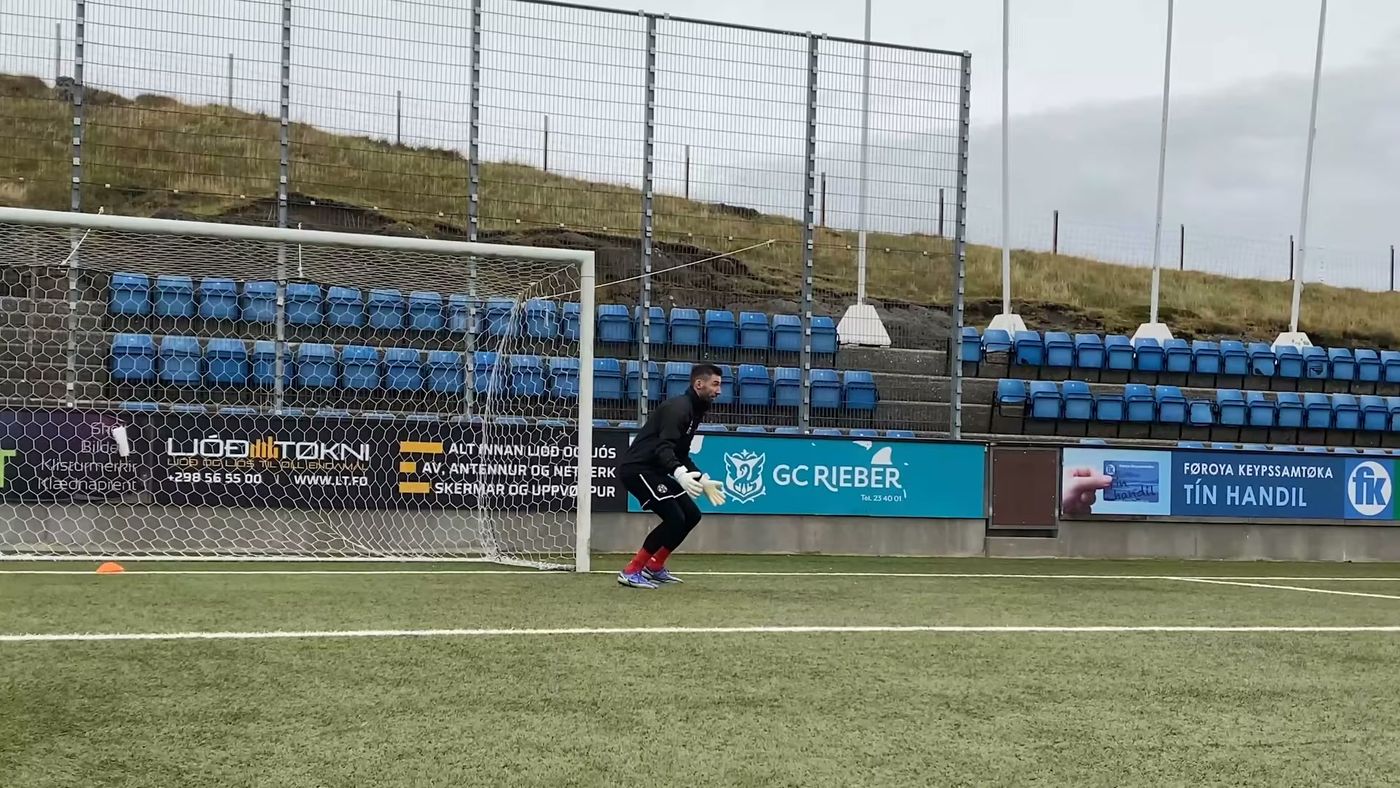
It works best on long-range 1v1s and from the side, where the angle is already narrow. That is not a big chance for him. So do not hand him a better one.
The mistake is running out and stopping in the middle of nowhere. Now he does not even need to beat you. He passes to a teammate, who rolls it into an empty net.
Trust your position, your training and your reactions. And if the striker keeps coming closer, that changes things. Then you go out with force and block it, or win it with a smother.
Why patience wins more 1v1s than speed is the whole idea behind goalkeeper 1v1s: when to come out and when to wait.
Which 1v1 technique covers what?
A quick way to keep the four apart.
| Technique | Use it when | Weak against |
|---|---|---|
| Smother | A through ball or a heavy touch you can reach | Late timing and the chip |
| Spread | Close and central, and the shot is coming | A touch round you, and between the legs |
| K save | Close, from the side, at a tight angle | Being too far away |
| Wait and react | Long range, or out wide | A striker who keeps coming, so go |
Once the shapes feel easy, rehearse them with a partner dribbling at you. The drills are in the 1v1 section of the drills library.
What to do this week
Learn the shapes slowly before you try them fast.
Slow shapes first. Speed later.
- The smother. Slide onto a still ball, both sides, one hand behind it and one on top, head behind it.
- The K. Drop into it slowly on both sides and check your hands are out wide, not tucked in.
- The spread. Get into it and find your stiff side. That side gets the mobility work.
- The wait. Next game, count how often you stay on your feet. Most 1v1s still start there.
None of this saves every 1v1 for the rest of your career. It is what has worked for me over more than 20 years in goal, so take it and find what works for you.
Can your body actually do these saves yet?
The spread needs hips that open. The smother needs you to get down fast and slide without holding back. The K needs quick, strong legs. And waiting needs reactions you trust once he shoots. None of that comes from reading about it.
The Ultimate Self-Training Program builds that base: low and high diving, footwork, flexibility and plyometric jump training, in a weekly plan built from over 120 drills you can do on your own. $27 a month.
See what is inside the plan 30-day money-back guarantee if it is not helping.
I have spent more than 20 years in goal, played over 500 competitive games, represented my national team and played in Champions League and Europa League qualifiers. I have coached over 1,000 goalkeepers, and the K save is still the 1v1 technique I enjoy most.
Enjoyed this article?
Find more great content here: