
Goalkeeper Footwork Drills: 7 You Can Do in a Two-Metre Square
Seven patterns in a two-metre square and five in the goal, built from the side step and the crossover, and all about getting set at every cone.
Feel like you are always one step short of the perfect save? The shot you nearly got to. The cross that dropped just behind you.
That is almost never a reflex problem. It is footwork, and footwork is the one thing you can train anywhere.
Here are the seven drills I use, all inside a two-by-two metre square with four cones, plus the five I run in the goal when I have a pitch.
The best goalkeeper footwork drills need four cones and two metres of space. Learn two movements first, the side step for short distances and the crossover for long ones, then run seven patterns around the square: forwards, sideways, backwards, then facing the middle, then in an S, then in a zigzag. Get set at every cone. Sharpness matters more than speed.
What are the two movements every drill uses?
Before the drills, two things you need to understand, because every pattern below is built from them.
The side step. Used over shorter distances, because it keeps you facing the ball and makes it easy to stop and get set. Lead with the foot closest to where you want to go, keep the steps short, and never let your feet come together.
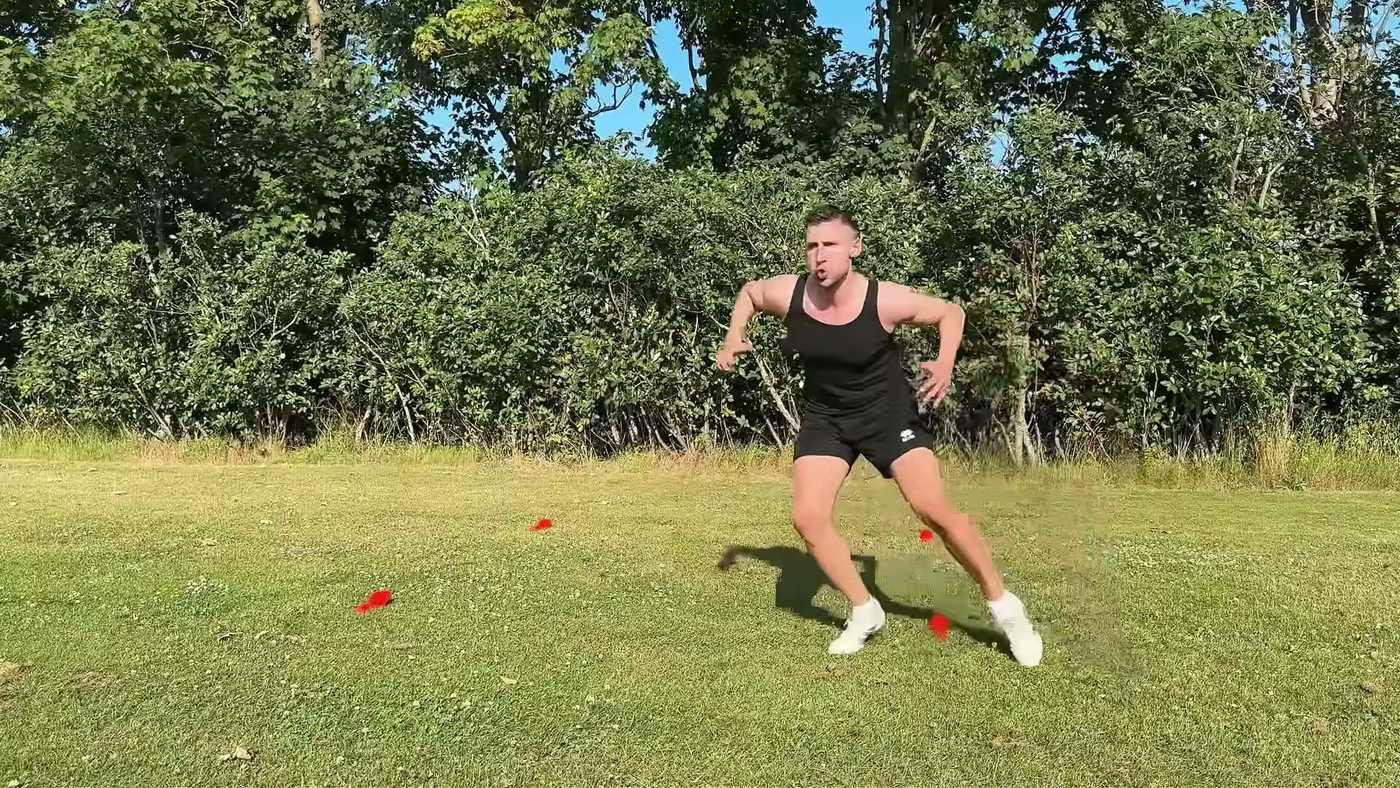
The crossover. For when there is more space to cover and the side step is simply not quick enough. It lets you travel further with every step. The problem is that you cannot make a save with your legs crossed, so as you arrive you have to slow down and get set before the shot comes.
That decision, which one and when, is the whole of the footwork guide. This post is the drills that make both automatic.
Drills 1 and 2: Can you get set at every corner?
Set your four objects out in a two-by-two metre square.
Round the square with side steps
Start at either bottom cone. Run forwards along the first side, side step across the top, back pedal down the opposite side, side step across the bottom. That is one round. Back at the start, change direction and do the same pattern the other way. Three rounds, rest at least 30 seconds, then three more starting from the opposite bottom corner. Two sets of three.
It looks simple and it is simple. Simple drills are what show you exactly where your footwork falls apart, especially when you get tired. Keep the side steps short and light, get set at every cone, and keep your chest slightly forward when you are moving backwards.
Round the square with crossovers
Same route, but replace the side steps with crossovers. Speed is not the hard part of this one. Stopping is. As you reach each corner, slow down and stop for half a second.
Drills 3 and 4: Can you move without losing the ball?
The first two drills were easy because your body faced the way you were moving. Now that goes.
Facing the middle, side steps
Pick a spot in the middle of the square. That is now the ball. Your job is to move around the whole square without losing sight of it. It feels awkward at first, especially at the corners, and that is fine. Start slowly and work out where your feet go before you add speed. Two sets of four rounds, 45 seconds rest between.

Your feet learn the route. Your eyes stay on the ball, the striker, and everything happening in front of you.
Facing the middle, crossovers
Same challenge, with crossovers. Ball still in the middle, chest and eyes still facing it as you move around the outside. You move faster now, and the corners get harder: slow down, get set, turn your body back to the middle before you move again.
The temptation is to turn and run. That gets you round the square quicker and it loses the ball. Keep the chest in, use the crossover to cover the distance, and accept that the first rounds look messy. Mine normally do too.
Drills 5, 6 and 7: What about the small adjustment steps?
So far every route has been predictable. Games are not. The ball changes direction, players block your view, and the position you found half a second ago is already gone. That is where the small adjustment steps come in, the ones positioning depends on.
For these three: three sets of two rounds, 60 seconds rest.
The S with side steps
Start at a bottom corner and use short side steps to weave in and out of the square, like drawing an S with your feet. At the top, side step across, repeat the S down the other side, and return. By now your legs are feeling it, and that is when feet start doing whatever they want. Do not chase depth through the S. Small steps, knees lightly bent, head up. The challenge is making your last set position look as sharp as your first.
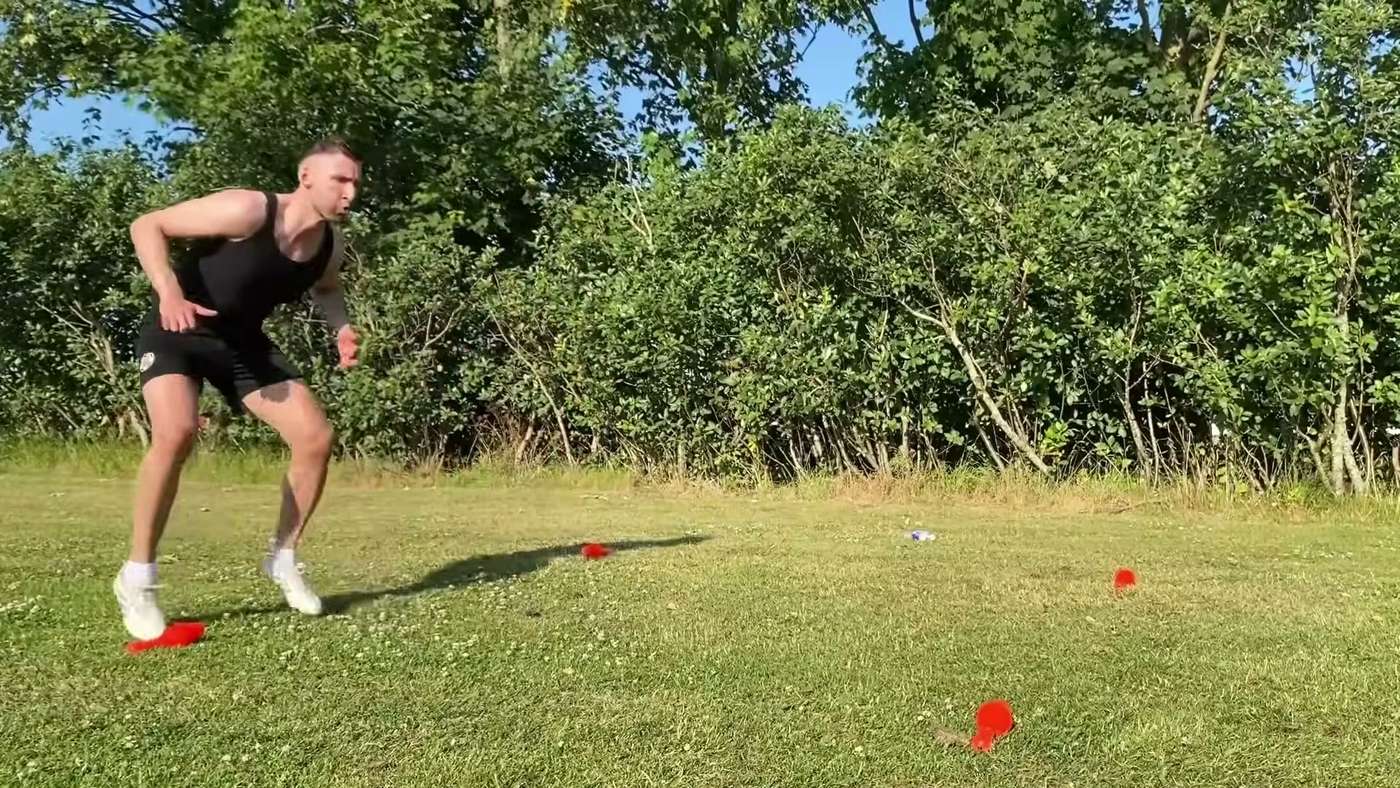
The S with crossovers
The same S, but with crossovers. Short steps through the first S, then open your stride and cross over to the other side. This one is about changing gears, because sometimes a goalkeeper needs two or three tiny steps to find the angle and then the ball travels across the pitch and you have to cover a big distance fast. If every step looks the same, slow down and exaggerate the difference.
The zigzag
Take away the smooth S and replace it with sharp zigzags. Diagonally in and out along the first side, planting your outside foot and pushing away into the next diagonal. Side step across the top, zigzag backwards down the other side, side step home. The word is sharp. Do not drift round each turn. Lower your body, plant the foot, push the ground away.
What if you have a goal to work in?
When I have the pitch, I run five more that copy real match movement, because a ladder never asks you to do what you do in a game.
Same warm-up first: light pre-activation, some easy touches on the ball, then quick feet between five cones across the goal.

- Stop and start: shuffle to each cone, stop completely, then explode to the next
- The cross step: from set, one sharp diagonal step landing just outside the planted foot
- Explode, stop, back pedal: a cone in the middle, drive to it, set, back pedal leaning forward
- Far post: cones by the post, two quick cross steps to get there before the ball
- Everything together: four cones across the goal, shuffle, cross step, shuffle, two cross steps
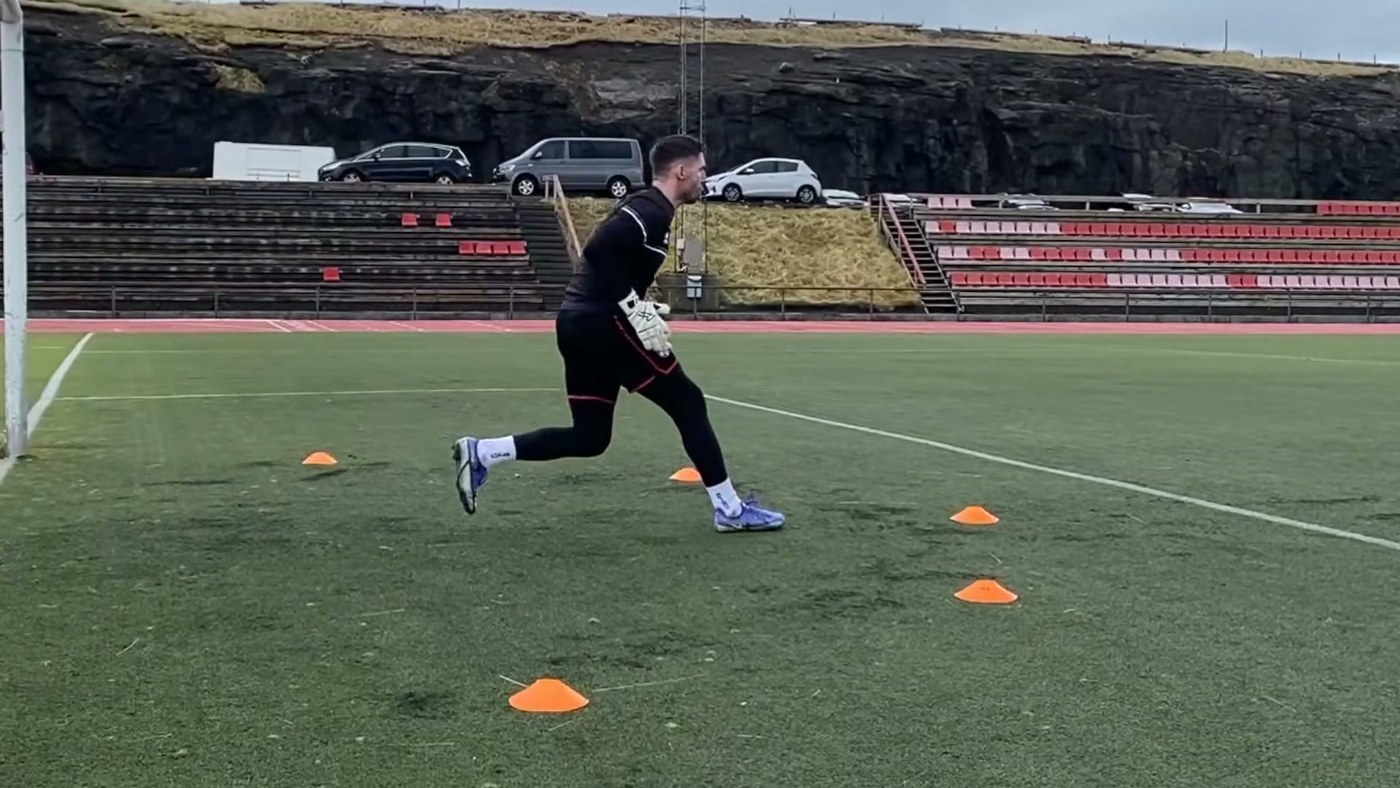
If you have a speed ladder, there is a full set of ladder drills on the channel too. Cones do the same job, because the goal is only ever to create spaces to step into. Here are the five in-goal drills in full:
Once these feel easy, add speed with my goalkeeper agility drills, a full speed session you can do alone.
What to do this week
Want the footwork itself on one page before you start the drills? It is in my free Goalkeeper Technique Playbook, next to 30 other techniques.
Drills one and two, every day, five minutes. That is the whole week.
- Set at every cone. Sharpness, not speed.
- Film the last round and compare it to the first. If the last set position is as sharp as the first, add drills three and four next week.
- Hips like concrete? Then the footwork was never the problem. Loosen up with a proper recovery routine first.
Fast feet are useless if you arrive in the wrong shape.
All twelve drills, with the rest of the movement work, are in the drills library.
Which drill goes in which week?
Footwork, handling, diving and the rest all need the same thing: the right drill in the right week, without you having to work out which is which.
That is what the Ultimate Self-Training Course is: 120+ drills laid out in a weekly plan. $27 a month.
Have a look at the program 30-day money-back guarantee if it is not helping.
I have played more than 500 competitive games, represented my national team, and played in Champions League and Europa League qualifiers. I have coached more than 1,000 goalkeepers. These are the drills I still do at 40 to keep my feet sharp.
Enjoyed this article?
Find more great content here: