
How to Train Your Weak Side as a Goalkeeper, Alone
Five drills that rebuild the weak-side dive from the knees up, and the two habits that make the work stick: film it, and do it daily.
You set yourself. You go for the dive to your weak side. And it just feels off. Slower, smaller, like a different goalkeeper is doing it.
You are not alone. Almost every goalkeeper has a weaker diving side, and strikers find it fast.
The good news is you can fix it on your own, with a ball, a bit of space and ten to fifteen minutes a day. Here is how, step by step.
To train your weak side as a goalkeeper, rebuild the dive from the ground up on that side only: from both knees, then one knee, then with a reach, then on your feet with a power step, then with a reaction cue. Keep the bottom hand tight to the ground and your chest over the ball. Ten to fifteen minutes a day, filmed, beats one long session a week.
Why does your weak side feel so bad?
Two reasons, and it helps to know which one is yours.
The first is technique. On your strong side, you have done the movement thousands of times without thinking. On the weak side, every part of it is slightly wrong at once: the step, the hand, the landing.
The second is leg strength. If one leg is weaker, you do not push off it as explosively, and the whole dive feels slow and awkward no matter how good the technique is.
Most goalkeepers have some of both. The drills below fix the first. The last section covers the second.
Drill 1: Why start on your knees?
I know what you are thinking: should we not be diving like in a match?
If you cannot get the technique right in a controlled position, it will only fall apart at full speed. So get on your knees, ball in your hands.

Instead of flopping over, focus on keeping your chest over the ball as you drop your body to the side. Both hands stay on the ball the whole time. Think of it as guiding yourself down rather than falling.
The big mistake here is twisting the body or landing flat on your back. Glide down through the side of your hip and thigh, smoothly, in control. If this feels too easy, good. That means you are doing it right.
Drill 2: What changes on one knee?
Now let's make it more realistic. In a game you never want to dive from a static position. Sure, it happens, but the ideal is always to take a step first.

Get into a half-kneeling position: one knee down, the other foot flat, as if you are about to step into the dive. Same idea as before. Drop into the dive, keep the lower hand low and strong, land in a controlled motion. No flopping, no slamming into the ground. Chest forward, and let the ball do the cushioning.
Drill 3: When does the reach come in?
Set up on both knees again, but this time the ball is not in your hands. Move it slightly further away to your weaker side, not crazy far, just enough that you have to reach for it.
Before you dive, take a small power step towards the ball. Yes, even from your knees. Then extend towards it, shoulder staying over the knee, lower hand tight to the ground.

If you let that hand drift up, there is a gap under your body, the ball slips through, and you concede. That is the whole reason the bottom hand matters, and it is the same push-out that the low dive guide is built on.
Get a few solid reps in. Stay smooth.
Drill 4: How do you take it to your feet?
If you take one thing from this whole post, take this: step first, dive second. Drop straight down and you are not covering anything. You are making it easy for the ball to sneak past you.
There are moments in a game when there is no time for a power step, but that is another topic. For now, keep it simple.
Take a step to your diving side, push off your back foot and step towards the ball, then drive into the dive with the lower hand close to the ground so nothing gets under you.
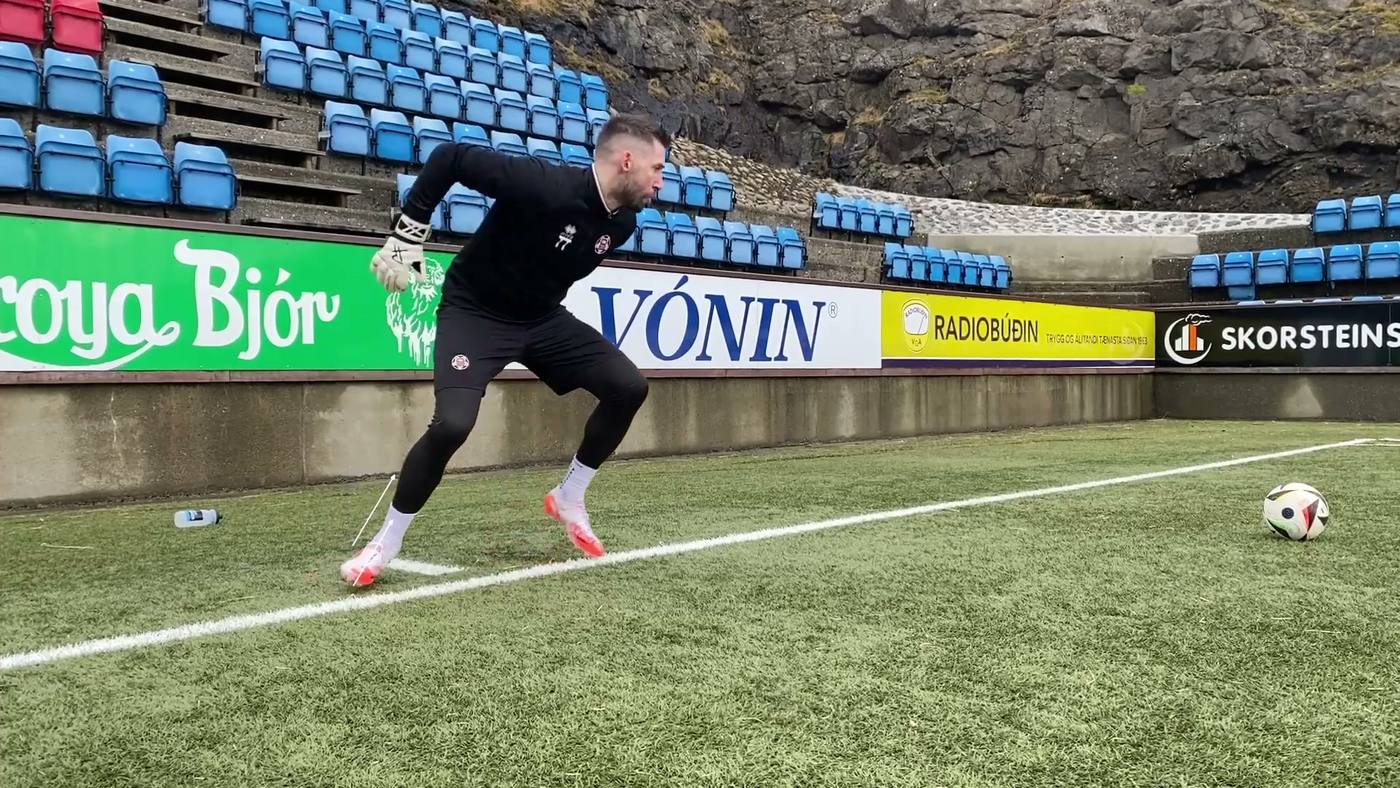
Two things to keep in mind. Your chest stays forward: lean back and your weight shifts the wrong way and you lose the dive. And do not dive flat, especially in training. A lot of goalkeepers fall sideways instead of pushing forward. Attack the ball whenever you can rather than just reacting to it.
Start small. Step, dive, secure the ball. Add speed and power only when it feels comfortable. If you have done drills one to three properly, this should already feel smoother than it did before.
Drill 5: How do you add a reaction?
Take a cone, a water bottle, anything, and place it one or two steps to the opposite side of your starting position.
Start in your set position. Instead of diving straight away, take a quick step to the opposite side and touch the cone with one hand. The moment you touch it, push off your back foot, step, and dive into the save on your weak side.
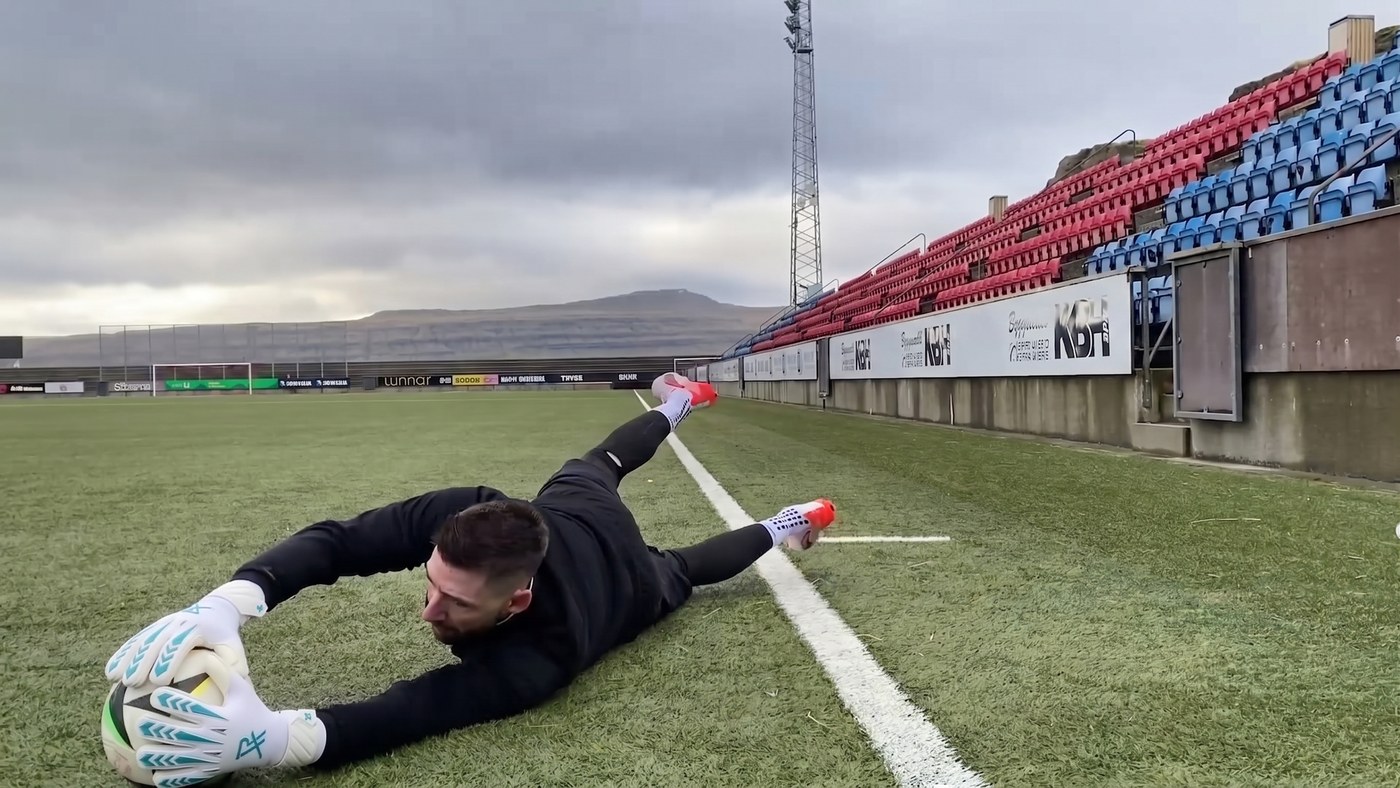
- Stay balanced: quick, controlled steps, no wild lunges
- Eyes on the ball the moment you touch the cone
- Dive through the ball, not just to it
This one works reactions, footwork and diving all at once.
How do you make sure it actually works?
Going through the motions is not enough. Four things.
Film yourself. What feels right does not always look right. You will think your bottom hand is in the right spot and then see on the phone that it is too high, which is exactly why the ball keeps going under you.
Make it a habit. Once a week or once a month changes nothing. Ten to fifteen minutes every day adds up fast, before or after team training, at home, in the garden.
Train both sides. This post is about the weak side, but ignore your strong side completely and you have made a new problem.
Work on leg strength. Sometimes the weak side is not technique at all. One weaker leg means one weaker push-off. The single-leg bounds in the jumping guide are how you close that gap.
And one more, the fastest fix I know: film your strong side, watch it, and copy it. Whatever you do naturally to your good side is your own technique working. You are not learning something new. You are copying yourself.
What to do this week
The diving chapter of my free Goalkeeper Technique Playbook has the low dive, the collapse dive and the high dive on one page each. Read it for your good side, then copy it to the other one.
Drills one and two only, weak side, ten minutes a day.
- Film one set on day one and one set on day seven.
- Look at the bottom hand and the chest. If both are where they should be, add drill three next week.
- If the fear is the thing stopping you, start with the fear-of-diving drills instead. Same kneeling start, different problem.
Strikers find your weak side in one game. You can fix it in a month.
All five drills, with the rest of the diving progressions, are in the drills library.
Who hands you the order of the drills?
The weak side is the clearest example of why random training fails: the fix is a specific order of drills, repeated, and nobody hands you that order.
The Ultimate Self-Training Course does. 120+ drills, diving progressions for both sides, in a weekly plan. $27 a month.
Have a look at the program 30-day money-back guarantee if it is not helping.
I have played more than 500 competitive games, represented my national team, and played in Champions League and Europa League qualifiers. I have coached more than 1,000 goalkeepers. I had a weak side for years before anyone told me to film it.
Enjoyed this article?
Find more great content here: