
The Goalkeeper Morning Routine: 6 Habits and 10 Minutes of Mobility
Six simple habits and the ten-minute mobility routine I use at 40, so you stop spending the first twenty minutes of every early game trying to wake up.
It's 9:00 on a Sunday morning. The warm-up starts, your legs feel heavy, and your reactions are slow.
You spend the first twenty minutes of the game trying to wake up. So you blame the early kick-off.
But the real problem probably started on Saturday.
A good goalkeeper morning routine is simple. Wake up at about the same time every day. Get out of bed before you open your phone. Move for a few minutes before you sit down. Eat a breakfast with some protein. Spend five to ten minutes on one weak part of your game. Then set it all up the night before.
Why do early kick-offs feel so horrible?
All week you wake up at 7:00 for school. Then the weekend comes, you stay up late and sleep until midday.
So when the alarm goes off early on Sunday, your body is not ready. It feels like you dragged it out of bed in the middle of the night.
This does not mean setting your alarm for 6:00 and sleeping four or five hours. Getting enough sleep still comes first, and I have written about how much sleep a young goalkeeper needs in my recovery guide.
But try to keep your wake-up time inside roughly the same one-hour window, weekends included. Before your next early kick-off, do not only think about when you go to bed the night before. Think about when you have been waking up all week. The rest of a match morning, from the kit bag to when to arrive, gets its own guide on the goalkeeper match day routine.
Should you check your phone as soon as you wake up?
This is one I am guilty of too. You pick up your phone to check one message, and the next time you look at the clock, twenty minutes have gone.
You are watching a goalkeeper make an unbelievable save in the third division of Argentina. Or worse, a cat doing backflips.
The phone is not the problem. The problem is that you have not even got out of bed and your head is already everywhere else.
One simple rule. Before you open social media, get out of bed, get dressed, open the curtains and drink some water. After that, check your messages. Watch the goalkeeper from Argentina if you really want to.
What should you do in the first five minutes out of bed?
This is the habit I notice the most now that I am 40.
When I was younger, I could get out of bed, do nothing at all, turn up to training and my body was somehow ready. That does not happen any more. If I wake up, sit at my desk for an hour and then expect my hips, hamstrings, back and shoulders to dive and jump, I feel old for the first few drills.
But even if you are 14, you have just spent seven, eight or nine hours lying in almost the same position. If the first thing you do after getting up is sit down again, your body never gets the chance to wake up.
So before you sit down, move for three, four or five minutes. Not a full workout. You do not need a hundred push-ups or a sweat. A few hip openers, a few lunges, turn your upper back, circle your shoulders.
If you have ten minutes, do the full routine below.
What is the 10-minute morning mobility routine?
These are the moves I use to open up my hips, loosen my hamstrings and get my body moving before training or a match. You can follow the whole thing with me in my morning mobility video.
Every move here is done for reps, moving in and out of the position. You are waking your body up, not holding long stretches.
- Lunge into hamstring stretch. Step into a forward lunge, then straighten your front leg and sit back into a hamstring stretch. Eight each side.
- World's greatest stretch. Big lunge, both hands inside your front foot, elbow towards the ground, then rotate and reach up. Watch your hand all the way. About eight each side.
- Side-to-forward lunge. On one knee, other foot out to the side. Push your hips towards that foot, then come back to the middle. About five each side.
- Hip circles on all fours. Lift one knee and draw a big circle with it. Keep the rest of your body still. About five each side.
- Kneeling side lunge with a twist. One knee down, the other leg out to the side. Push your hips back, come up and rotate. About eight each side.
- 90/90s. Sit with both knees bent and lower them to one side, then the other. About eight each side.
- Open book. On one knee, arms straight out in front. Rotate one arm and your upper body back, then close the book again. Keep your hips still. About eight each side.
- Lying hamstring. On your back, pull one knee to your chest, then straighten and bend the leg. Ten each side.
- Thread the needle. On hands and knees, slide one arm under your body, then bring it up to the sky and follow it with your eyes. About ten each side.
- Pigeon hold. One knee bent in front of you, the other leg straight behind. The only hold in the routine: about 15 seconds each side.

Don't force any of it. Go a little further as you loosen up. My hamstrings are always stiff first thing, and my left side is stiffer than my right. I have had two operations on my left knee, so I am not surprised.
And don't worry if the floor feels further away some mornings. After 40 years, I have accepted it.

This is not your warm-up. Before training or a match you still need a proper goalkeeper warm-up with the ball. And if you want longer holds after a session or before bed, that is what my 12-minute goalkeeper stretches routine is for.
This routine is about waking the body up, not fixing pain. If your goalkeeper has knees or hips that hurt regularly, that is a question for a physio or a doctor, not a stretching video.
Should you do it on match days or every day?
Someone asked me this under the video. My answer: every day, or at least every day you have training.
Ten minutes is small enough to fit before school. It is also the easiest thing to skip, which is why the last habit on this list matters so much.
What should a goalkeeper eat for breakfast?
This is where a lot of young goalkeepers make the morning harder than it needs to be.
You leave the house with an energy drink or whatever biscuit you found in the cupboard, and expect it to carry you through school and training later. You might feel fine for a little while. But by the time training starts, you are hungry, your energy has dropped, and concentrating for the whole session is much harder.
Your breakfast does not need a Premier League chef. Keep it simple:
- eggs and toast
- yoghurt and fruit
- oats with milk
- a quick smoothie if you are running late
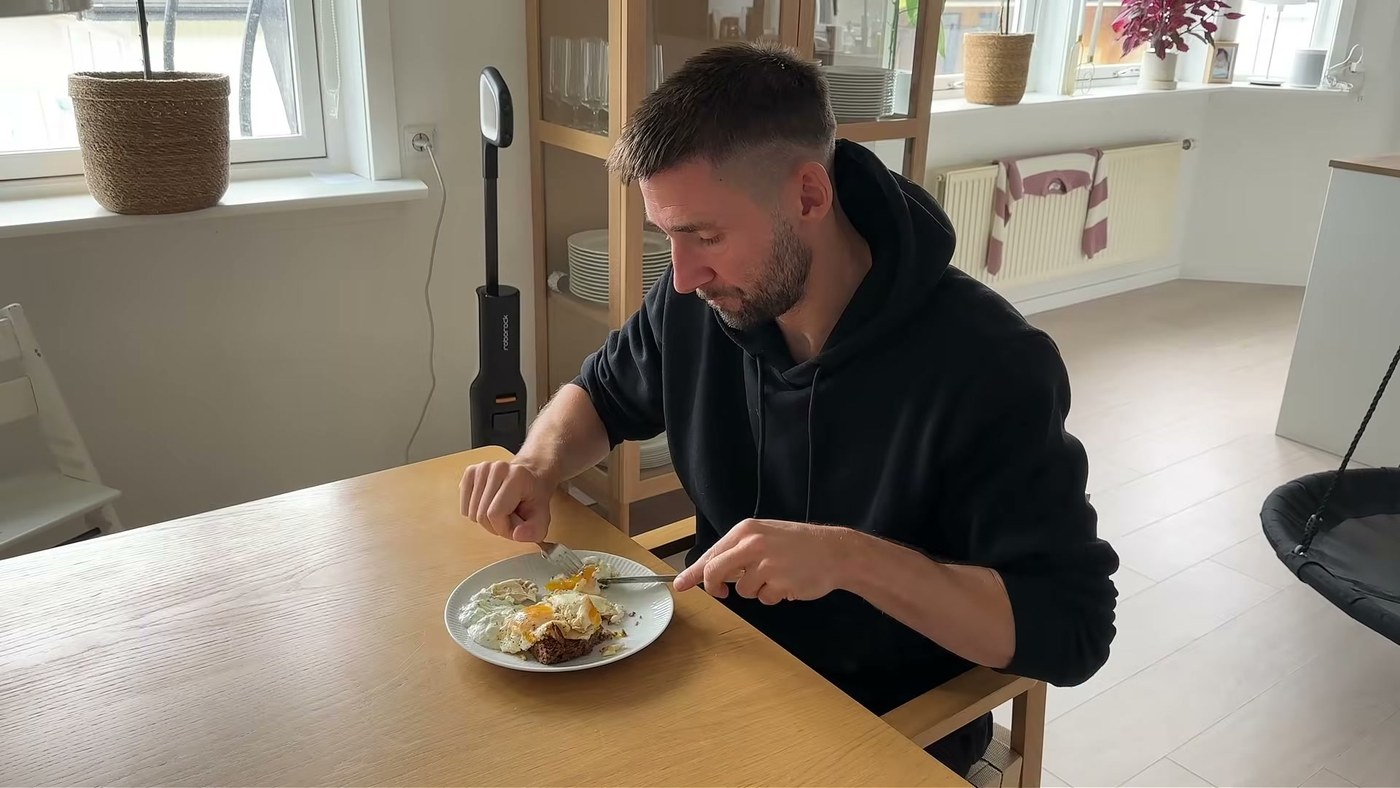
Try to eat something that keeps you full, gives you energy and has some protein in it where you can.
If you struggle to eat in the morning, do not force down a huge meal. Have something smaller, then bring food you can eat later.
What can you train in five minutes before school?
Open TikTok, Instagram and YouTube. How many goalkeeper drills have you saved? Ten? Twenty? Hundreds?
Now be honest. How many have you actually tried? And how many more than once?
A lot of goalkeepers spend so much time collecting drills that they forget to train. You think you need a pitch, a goalkeeper coach, ten balls and an hour. You do not. Pick one part of your game every morning and give it five to ten minutes. If you are not sure which part, my guide to building your own goalkeeper training plan shows you how to work it out.
- If your weak foot is the problem, make clean passes against a wall.
- If your first touch keeps letting you down, do a few minutes of ball mastery.
- If you struggle to catch cleanly, do some simple hand-eye coordination drills.

It does not need to look impressive. It does not need to turn into a full session. Five to ten minutes on a real problem will do more for you than saving another ten drills you will never use.
And yes, making up your own drill is completely fine, as long as it works on the thing you actually need. If you want ideas, the drills library sorts them by skill.
Why does the night before decide your morning?
A lot of morning routines fail before the alarm even goes off.
When you wake up tired, you do not want to make decisions. What are you wearing? What are you eating? Where is your water bottle? Which five-minute drill were you supposed to do?
The more you have to think, the easier it is to grab your phone, rush out of the house and tell yourself you will start properly tomorrow.
So before bed:
- Put your clothes out
- Fill your water bottle
- Have something ready for breakfast
- Pack your goalkeeper bag if you have training
- Decide exactly what your five to ten minutes will be
If you are working on your weak foot, leave the ball where you can see it. If you are doing mobility, have the mat ready. If you are working on your handling, you could sleep in your gloves. Okay, maybe not. But you get the point.

When someone asked me which habit matters most, this was my answer. It is the boring one. But without it, everything else falls apart.
What to do tomorrow morning
Don't try to fix all six at once. Start tonight: decide tomorrow's five minutes and leave the ball where you will see it.
Someone under the video asked me for a chart of the habits. Here it is.
The six habits, on one card
- Same wake-up time. Within about an hour every day, weekends too.
- Up before the phone. Out of bed, dressed, curtains open, a glass of water.
- Move before you sit. Five minutes, or the full ten-minute routine.
- Real breakfast. Some protein, or food packed for later.
- One thing, five minutes. One part of your game, not ten saved drills.
- Set it up tonight. Clothes, bottle, bag and tomorrow's drill.
The last one is the boring one. It is also the one that makes the other five happen.
Know which five minutes to train?
The five minutes are easy. Knowing which five minutes will actually make you better is the hard part, and most young goalkeepers end up guessing.
The Ultimate Self-Training Course gives you a clear weekly plan, over 120 drills you can do at home, and a flexibility and movement reset made for goalkeepers. $27 a month.
See the weekly plan 30-day money-back guarantee if it is not helping.
I have played more than 500 competitive games, represented my national team, and played in Champions League and Europa League qualifiers. I have coached over 1,000 goalkeepers. At 40 I still play, and my body needs a lot more waking up in the morning than it did at 16.
Enjoyed this article?
Find more great content here: